Helping design and engineering professionals discover, evaluate and specify technologies and processes that shorten the design cycle and enable success.



Digital Engineering April 2026
In the latest issue of Digital Engineering, we take a look at the latest innovations in design for additive manufacturing, including the use of natural language inputs, social media cosplayers, and AI integration. The issue also includes a feature…

January Special Focus Issue: Design for Additive
In this Special Focus Issue of Digital Engineering, learn about the latest advancements in design for additive manufacturing, including new software tools, additive in automotive, custom medical devices, and more.
NASA’s long-range plans for space exploration include the idea of extraterrestrial mining, generally targeting the leftovers of creation more commonly known as asteroids. The space agency has explored a number of different possibilities for asteroid mining, and has also reached out to the private sector for additional ideas. Made in Space has risen to the challenge with the idea of leveraging additive manufacturing (AM) to convert asteroids into autonomous spacecraft that transport themselves to mining facilities.
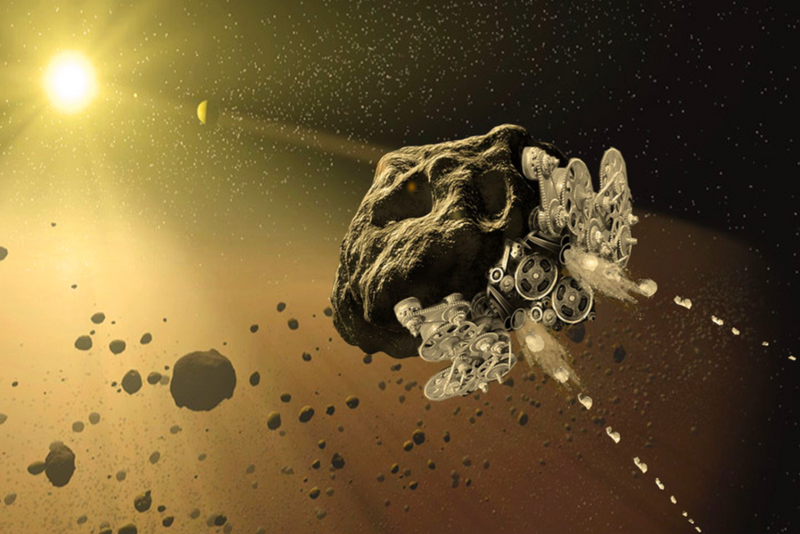 A Project RAMA autonomous asteroid-spacecraft on its way to the moon to be harvested. Courtesy of Made in Space.
Made in Space has already contributed to our future in space with its work on 3D printing capable of operating in a zero-g environment. Its new idea is much more ambitious, but continues to build on the company’s previous work. From the website:
Project RAMA — Reconstituting Asteroids into Mechanical Automata, is designed to leverage future advances of additive manufacturing (AM) and in-situ resource utilization (ISRU) to realize enormous efficiencies in asteroid redirect missions. In other words, we’re studying what it would take to turn asteroids into self-powered spacecraft.
The name Rama is probably recognizable to anyone familiar with the works of Arthur C. Clarke, but there won’t be any mystery about where the asteroids moving toward the Earth might have come from.
The basic plan is to send out a seed craft to intercept a near-Earth (near in the astronomical sense) asteroid. The craft will set down and begin to harvest raw materials. Those materials will then be used to fuel AM systems, which will print out the mechanical parts necessary to convert a floating quarry into a mobile resource.
Along with analog-based navigational aids, energy storage and attitude control. Propulsion will be accomplished via mass drive, which will eject non-viable materials from the craft to push it in the opposite direction. The spacecraft, which will be identified as RAMA-1, will move toward the moon where it can be harvested for materials.
According to Made in Space, the plan could go into operation at some point in the 2030s. Below you’ll find a video about asteroid mining.
Source: Made in Space


John Newman is a Digital Engineering contributor who focuses on 3D printing. Contact him via [email protected] and read his posts on Rapid Ready Technology.
Follow DE
Join over 90,000 engineering professionals who get fresh engineering news as soon as it is published.






About Us · Contact Us · Editorial Team · Advertising · Privacy Policy · Subscriber Services · © 2026 Digital Engineering 24/7 · Peerless Media