Helping design and engineering professionals discover, evaluate and specify technologies and processes that shorten the design cycle and enable success.



May 2026 Special Focus: Artificial Intelligence in Design and Simulation
In this Special Focus Issue, learn about the latest developments in the integration of artificial intelligence into engineering workflows.

April 2026 Special Focus Issue: Generative Design
In this Special Focus Issue, Digital Engineering takes a look at how generative design solutions can be used across different types of design problems and with a variety of manufacturing approaches to accelerate design space exploration, and…
The problem with designing for 3D is that it requires a large amount of technical knowledge to produce a unique design. While a number of potential solutions to that problem are in the works, researchers at Lancaster University have come up with a new method they call bidirectional fabrication, or ReForm. This proposed solution uses clay as part of the design process, allowing for direct, manual manipulation of an object simultaneously with digital design.
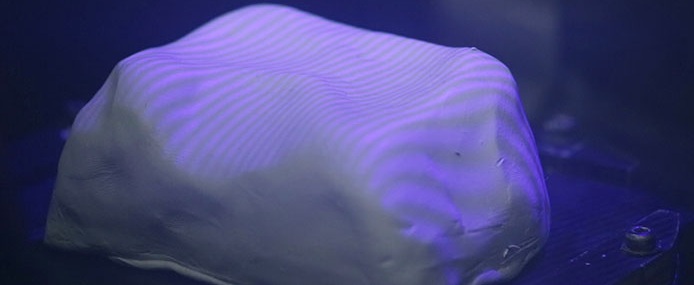
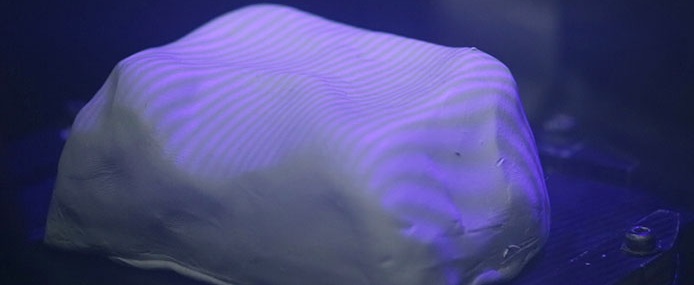 The secret at the heart of ReForm is this little block of clay. Courtesy of Lancaster University.
Beyond the purely technical difficulties, computers aren’t the perfect arena for design. While a computer is great at straight lines and symmetrical objects, humans are far better at creating rounded or asymmetrical designs with their hands and a pliable material. ReForm combines the potential of human creativity and CAD, along with subtractive methods.
It all starts with a block of clay. The basic shape of the object can be drawn, molded or carved into the clay. A 3D scanner is then used to translate the object into a digital design, where further modifications can be made. Those modifications are then translated back into the physical using subtractive methods such as milling or drilling, adding machine precision to the work.
“Before you had to be an expert in computer aided design. ReForm means you no longer have to be a technical expert to design objects for 3D printing. People can get hands-on and iteratively and inexpensively design objects in a much more efficient way,” said Dr. Jason Alexander, a lecturer in Human-Computer Interaction and project lead. “We will find that people will be able to create artefacts for 3D printing that are a lot more creative and fit for purpose.”
The ReForm system can also change the physical characteristics of the model by adding material to the object, either by hand or through AM techniques. All changes made to the model are recorded during the design process, allowing designers to rewind if they make a mistake, wish to make changes, or just happen to drop the clay model.
The final object is then scanned to produce a 3D design ready to be printed. The process is further described in the paper “ReForm: Integrating Physical and Digital Design through Bidirectional Fabrication,” which was presented at UIST, in North Carolina. Below you’ll find a video about ReForm.
Source: University of Lancaster


John Newman is a Digital Engineering contributor who focuses on 3D printing. Contact him via [email protected] and read his posts on Rapid Ready Technology.
Follow DE
Join over 90,000 engineering professionals who get fresh engineering news as soon as it is published.






About Us · Contact Us · Editorial Team · Advertising · Privacy Policy · Subscriber Services · © 2026 Digital Engineering 24/7 · Peerless Media