Helping design and engineering professionals discover, evaluate and specify technologies and processes that shorten the design cycle and enable success.



Digital Engineering April 2026
In the latest issue of Digital Engineering, we take a look at the latest innovations in design for additive manufacturing, including the use of natural language inputs, social media cosplayers, and AI integration. The issue also includes a feature…

January Special Focus Issue: Design for Additive
In this Special Focus Issue of Digital Engineering, learn about the latest advancements in design for additive manufacturing, including new software tools, additive in automotive, custom medical devices, and more.
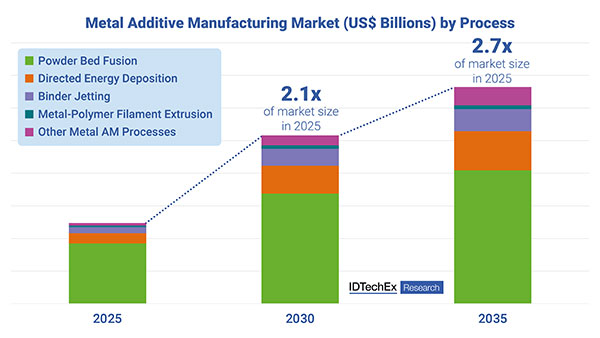
Metal additive manufacturing (AM) has shown strength in recent years. As more users identify end-use applications for metal 3D-printed parts in sectors like aerospace, automotive, and manufacturing, it is recognized that the industry is maturing beyond prototyping and tooling, advancing toward high-value applications. This can assist the metal AM hardware and materials market in nearly tripling its market size by 2035, according to IDTechEx's report "Metal Additive Manufacturing 2025-2035: Technologies, Players, and Market Outlook".
Even in this highly differentiated billion-dollar industry, broader trends are still shaping the metal AM industry's direction, both in the short- and long-term. IDTechEx discusses the impact of three major trends; one technology-focused, one regional, and one macroeconomic - on the status of metal additive manufacturing.
Powder bed fusion: Undisputed technology leader of metal AM
In the past several years, there has been hype around growing metal AM technologies, including metal binder jetting (MBJ) and metal-polymer filament extrusion (MPFE) (also known as bound metal extrusion). Capabilities of these technologies promised increased adoption by end-users who were otherwise not well-served by incumbent metal 3D printing technologies. However, the past several years has proven that laser powder bed fusion (LPBF), the first metal AM technology, has been and will remain a leader of metal AM technologies, according to IDTechEx forecasts.
Part of this stems from LPBF's maturity as a technology. As the first metal AM technology to be commercialized, it is backed up by years of manufacturer and end-user experience that enable it to be used effectively. In many cases, end-users of growing technologies, like MBJ and MPFE, are still working to address pain points in these processes and to identify applications where these processes, particularly MBJ, are technologically and economically advantageous.
Additionally, LPBF is a versatile technology. Depending on the configuration of the printer (i.e. build size, number of lasers, etc.), LPBF can be used for small injection molds to massive rocket engines. In contrast, MPFE is best suited for prototyping, jigs, and fixtures, while MBJ is best for high volumes of small to medium-sized parts that have geometries compatible with the sintering process. The versatility of LPBF ensures that the technology will continue to lead the metal AM industry in revenue over the next decade.
China: Metal AM's fastest growing region
The regional growth of the Chinese metal 3D printing market is one of metal AM's biggest stories. As the Chinese metal AM market has largely remained domestic, awareness of this fact in North America and Europe was relatively low up until the past few years. Chinese LPBF manufacturers like BLT, HBD, and EPlus3D have grown substantially over the past decade to serve a domestic audience that largely preferred local, cost-competitive suppliers over incumbent players like EOS and SLM Solutions.
Tariffs: A double-edged sword for metal AM
Currently, the implementation of tariffs is creating headwinds and tailwinds for the metal additive manufacturing industry. These tariffs are meant to encourage domestic manufacturing in the US. For onshoring to occur, extensive amounts of automation would be required, which can be supported through metal additive manufacturing. Additionally, metal AM's fast turnaround times can help speed up timelines to set up manufacturing operations. In theory, metal AM as an enabler for manufacturing operations means that the metal AM industry could benefit from increased domestic manufacturing caused by tariffs.
Metal additive manufacturing market forecasts and trends
IDTechEx's report, "Metal Additive Manufacturing 2025-2035: Technologies, Players, and Market Outlook", forecasts future revenue, install base, and materials demand for the metal AM market while carefully segmenting the metal AM technology and materials market by 10 process categories and 9 metal material categories. Additionally, IDTechEx analyzes each metal printing technology and provides detailed discussion on the metal AM materials market.
For further information on this market, including interview-based profiles of the main players, technology benchmarking studies, granular 10-year market forecasts, and application case-studies, please visit www.IDTechEx.com/MetalAM. Downloadable sample pages for this report are also available.
Sources: Press materials received from the company and additional information gleaned from the company’s website.


DE's editors contribute news and new product announcements to Digital Engineering. Press releases may be sent to them via [email protected].
Follow DE
Join over 90,000 engineering professionals who get fresh engineering news as soon as it is published.






About Us · Contact Us · Editorial Team · Advertising · Privacy Policy · Subscriber Services · © 2026 Digital Engineering 24/7 · Peerless Media