Helping design and engineering professionals discover, evaluate and specify technologies and processes that shorten the design cycle and enable success.


The Anark Core Platform, says developer Anark Corp. (Boulder, CO), creates an efficient, repeatable process for transforming and delivering IP-protected MCAD geometry throughout the enterprise supply chain and support organizations. Anark Core Platform consists of two main components: Anark Core Workstation and Anark Core Server – as well as a complementary software development kit and client tools.
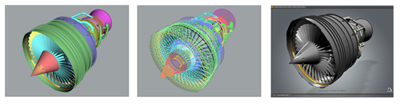
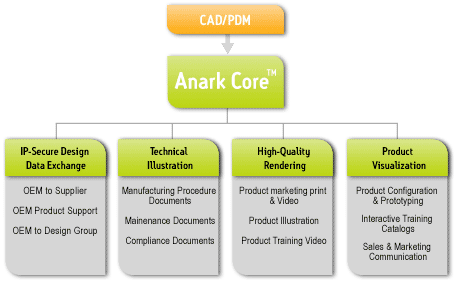
Anark Core 's MCAD transformation capabilities let you produce both high-precision (B-reps) and lightweight (mesh) product geometry for use in a variety of upstream and downstream applications, such as data exchange, aftermarket product support, technical publications, interactive catalogs, and product visualization, training, and marketing communications. The full Anark Core Platform system offers automation capabilities that eliminate manual reworking of product data as it evolves or as requirements change by enabling you to reapply a set of user-defined transformation operations.
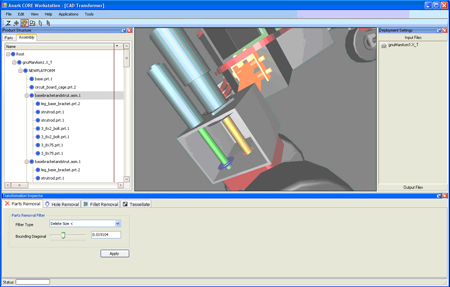
Anark Core Workstation, an authoring environment from which you transform your MCAD geometry, serves as the foundation of the Anark Core Platform. Designed to work as a standalone application or in conjunction with Anark Core Server, you use this application to import MCAD data, identify parts, instances, assemblies, and geometry features, then modify or remove parts and features from individual components or complete assemblies as required. You can then export your transformed MCAD geometry in an assortment of formats as either high-precision B-reps or lightweight mesh data. Anark Core Workstation supports such widely deployed proprietary and open-standard geometry formats as CATIA V4/CATIA V5, IGES, Parasolid, Pro/Engineer, STEP, and VDA.
From within Anark Core Workstation, you can create what the developer calls “automation recipes.” Automation recipes are intelligent descriptions of geometry transformation operations that allow the MCAD geometry processing to be performed repeatedly, even as the source geometry evolves. It is these recipes that, when coupled with Anark Core Server, let you define and schedule automation jobs. As well, you can save automation schedules to a shared schedule database.
Anark Core Server itself is a scalable server system for high-volume, high-change environments. In addition to automating the transformation process based on the recipes created with Core Workstation, it maintains coherency between managed MCAD repositories even as product geometry changes. Anark Core Server provides an XML service-oriented architecture (SOA) using SOAP over HTTP/HTTPS, enabling integration with such enterprise software systems as PDM, ERP, and ECM. It can be distributed across a cluster of server boxes and across multiple CPU cores.
The Anark Core Platform runs on 2GHz or better AMD Athlon or Intel Pentium 4 Xeon systems. Minimum requirements include 2GB to 4GB of RAM, 5GB of disk space, Windows XP Professional 32 bit, Microsoft .NET 2.0, and NVIDIA GeForce 7 series, Quadro FX 1500, or better graphics card. Anark Core Server requires Windows Server 2003 and supports both Microsoft SQL Server Enterprise and Standard edition.
For additional information about the Anark Core Platform, click here.


Anthony J. Lockwood is Digital Engineering's founding editor. He is now retired. Contact him via [email protected].
Follow DE
Join over 90,000 engineering professionals who get fresh engineering news as soon as it is published.






About Us · Contact Us · Editorial Team · Advertising · Privacy Policy · Subscriber Services · © 2026 Digital Engineering 24/7 · Peerless Media