Helping design and engineering professionals discover, evaluate and specify technologies and processes that shorten the design cycle and enable success.



Digital Engineering April 2026
In the latest issue of Digital Engineering, we take a look at the latest innovations in design for additive manufacturing, including the use of natural language inputs, social media cosplayers, and AI integration. The issue also includes a feature…

January Special Focus Issue: Design for Additive
In this Special Focus Issue of Digital Engineering, learn about the latest advancements in design for additive manufacturing, including new software tools, additive in automotive, custom medical devices, and more.
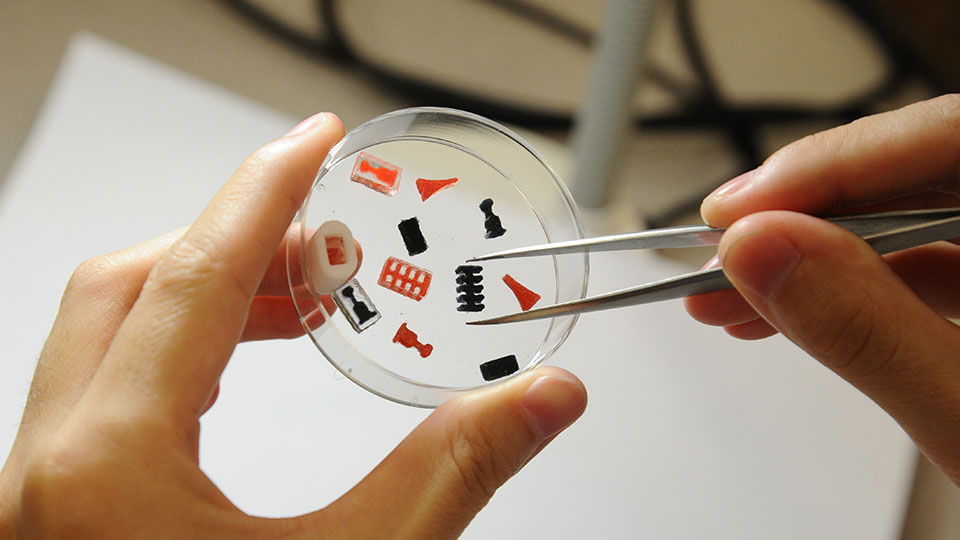
Researchers at the National University of Singapore (NUS) may have developed a new system for manufacturing pills that will actually eliminate the container. Instead of taking multiple pills each day, or multiple pills several times a day, the system would allow people to take one pill that combines the effects of multiple pills in a single swallow. As is the case with many recent medical developments, the key behind the research is additive manufacturing (AM).
 Courtesy of NUS.
Although the idea of using 3D printing to build drugs isn’t unique, it’s still a relatively new concept. While 3D printed drugs are useful in a number of circumstances, they are currently limited to low dosages and have a tendency to dissolve fairly rapidly. Unlike companies such as Apprecia that are using the technology to directly print medicine, NUS’ approach takes advantage of AM’s flexibility to personalize medication without relying on it to build the actual pill.
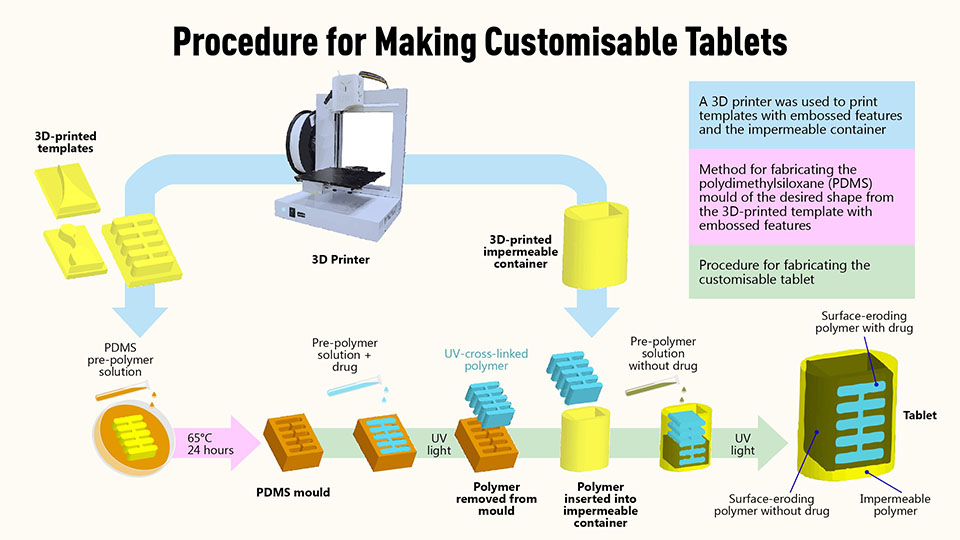
The process begins with a doctor using a program to design the contents of the pill and the dosages required. Unlike other AM programs, this doesn’t require any CAD knowledge, but rather acts more like virtual Lego allowing doctors to construct a pill in the shape most conducive to a patient’s needs. From the NUS report:
The doctor or pharmacist draws a desired release profile in design software, which then instructs a three-dimensional (3D) printer to fashion a mould for the drug. This mould shapes drug-infused polymers of specific release profiles, which are placed into an impermeable casing. A solution of surface-eroding polymer, which solidifies when cured under UV light, fills the gaps in between.
As an example, for a patient that takes five pills each day, or is required to take one pill five times a day, the pill could be shaped with five prongs. Each prong is set to dissolve at a certain rate, ensuring all the day’s needs are accounted for in a single pill. This method of delivery can also assist with delivery of specific levels of a drug by ensuring a steady release of the drug over an extended period of time.
Below you’ll find a short video about 3D printing drugs.
Source: NUS


John Newman is a Digital Engineering contributor who focuses on 3D printing. Contact him via [email protected] and read his posts on Rapid Ready Technology.
Follow DE
Join over 90,000 engineering professionals who get fresh engineering news as soon as it is published.






About Us · Contact Us · Editorial Team · Advertising · Privacy Policy · Subscriber Services · © 2026 Digital Engineering 24/7 · Peerless Media