Helping design and engineering professionals discover, evaluate and specify technologies and processes that shorten the design cycle and enable success.



May 2026 Special Focus: Artificial Intelligence in Design and Simulation
In this Special Focus Issue, learn about the latest developments in the integration of artificial intelligence into engineering workflows.

April 2026 Special Focus Issue: Generative Design
In this Special Focus Issue, Digital Engineering takes a look at how generative design solutions can be used across different types of design problems and with a variety of manufacturing approaches to accelerate design space exploration, and…
With virtually every industry segment and every product more dependent on embedded software, manufacturers are scrambling to get software development under control, especially since it's historically been a fairly isolated and siloed process, noted Dennis George, senior marketing manager for Teamcenter at Siemens. "We need to make sure software becomes an inherent part of the product development lifecycle and to do that, we need to make sure software tools and software processes are integrated into the PLM environment, George explained. "The Polarion acquisition helps us fulfill our systems-driven product development vision."
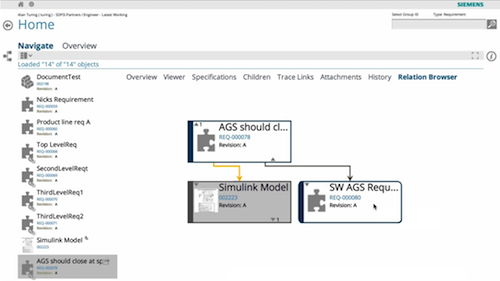
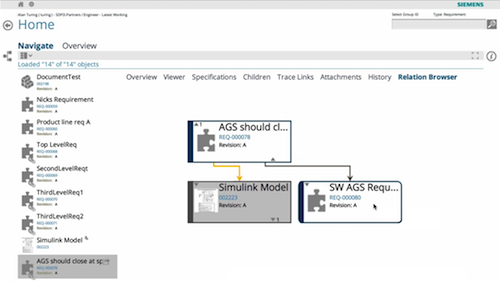 Product managers and engineers can easily visualize how software requirements defined in Polarion are linked to the overall product requirements. Image Courtesy of Siemens PLM Software
While Teamcenter has had capabilities for capturing software requirements in tandem with product requirements, there were gaps in functionality—specifically the ability to manage at the source code level as well as support for creating the actual software architecture and managing embedded test and verification resources, George said.
Polarion was the right fit for Siemens, he explained, because of its 100% browser-based orientation, open architecture and unified platform covering requirements, quality and ALM. Polarion has more than 2.5 million users worldwide, in industries similar to Siemens, including aerospace, automotive and medical devices. Polarion's Web-based orientation, in particular, is what sets it apart from other ALM offerings, George maintained. "It makes it much easier to share information, to link to information, and to access it across multiple tools and domains," he explained. This is critical, he added, because most software engineers will continue to want to use their existing tool sets, thus it's important to make it easy to get data in and out of the core PLM platform.
Siemens also differentiates its PLM-to-ALM offering for delivering bi-directional traceability between hardware and software requirements, which means engineers no longer have to update data in multiple places, he said. Siemens' open architecture, coupled with Polarion's support for Open Services for Lifecycle Collaboration (OSLC), a standard for integrating software tools, also makes it easy to create a closed loop between PLM and other software platforms, he said.
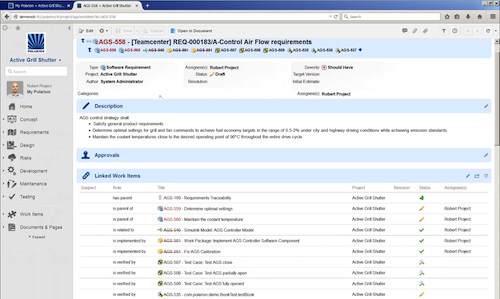 The software engineer can see and access project requirements and other linked objects and their relationships managed in Teamcenter, including optimal settings, models used, and test cases to be run. Image Courtesy of Siemens PLM Software
While the Polarion acquisition isn't expected to close until first quarter of 2016, the companies have already done integration work thanks to an on-going partnership.
Check out this video to get a basic overview of Polarion ALM.


Beth Stackpole is a contributing editor to Digital Engineering. Send e-mail about this article to [email protected].
Follow DE
Join over 90,000 engineering professionals who get fresh engineering news as soon as it is published.






About Us · Contact Us · Editorial Team · Advertising · Privacy Policy · Subscriber Services · © 2026 Digital Engineering 24/7 · Peerless Media