Helping design and engineering professionals discover, evaluate and specify technologies and processes that shorten the design cycle and enable success.



May 2026 Special Focus: Artificial Intelligence in Design and Simulation
In this Special Focus Issue, learn about the latest developments in the integration of artificial intelligence into engineering workflows.

April 2026 Special Focus Issue: Generative Design
In this Special Focus Issue, Digital Engineering takes a look at how generative design solutions can be used across different types of design problems and with a variety of manufacturing approaches to accelerate design space exploration, and…
SmartCAMcnc has announced the field test release of SmartCAM V18.0. Version 18.0 delivers new milling functionality to the SmartCAM milling suite, and several modeling and toolpath editing enhancements to the entire SmartCAM suite of computer-aided manufacturing (CAM) system software. General release of the software is expected for June of this year.
The SmartCAM product family consists of applications for computer-numerical control (CNC) milling, turning, fabrication and wire EDM. Version 18.0 is built on two central themes: core milling improvements, and core modeling and toolpath editing enhancements requested by customers.
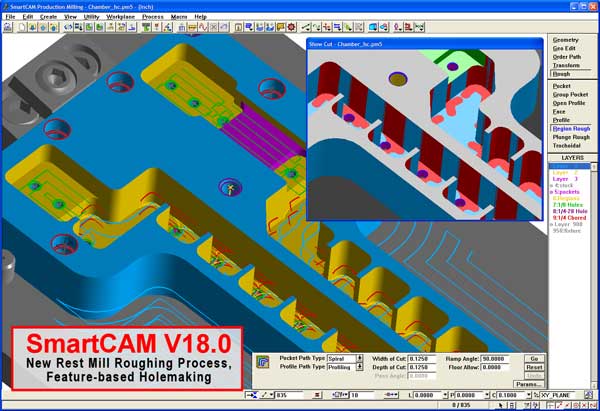
The new Rest-Mill Roughing capabilities, one of three a major core milling improvements in SmartCAM V18.0 milling applications, allow users to identify areas of remaining material, then machine those areas using a new Region Rough process. The Region Rough process machines the rest mill regions by automatically switching between profiling and pocketing strategies, depending on whether a region is open or closed.
In addition to the Rest Mill Roughing improvements, V18.0 introduces new Feature-based Hole-Making capabilities. Solid model hole-feature recognition has been enhanced to automatically identify compound hole-features, and create corresponding hole-feature elements that include full parametric detail of the hole. A new Hole Making process allows toolpaths to be created by applying hole-making tools to a group of hole-feature elements, and automatically determining the start levels and hole depths from the input hole-features.
“Our last SmartCAM release focused on solids machining improvements in our advanced milling applications. For V18 we decided to concentrate on core milling functionality that will also benefit our SmartCAM Production Milling users,” says Douglas Oliver, SmartCAMcnc’s senior product manager. “The wireframe rest-mill roughing and feature-based holemaking are fundamental capabilities that will be a huge time saver for all our milling users.”
The third core milling improvement found in SmartCAM V18.0 is a set of enhancements related to the Helical Milling. Helix elements can now be created with left- or right-offset properties, and can be offset during verification and code generation. The Thread Milling process has been enhanced to take advantage of the new helix offsetting capabilities, as well as adding support for single point tools, tapered threads, multiple-side passes, and a user-specified lead extension.
For more information, visit SmartCAMcnc.
Sources: Press materials received from the company and additional information gleaned from the company's website.


DE's editors contribute news and new product announcements to Digital Engineering. Press releases may be sent to them via [email protected].
Follow DE
Join over 90,000 engineering professionals who get fresh engineering news as soon as it is published.






About Us · Contact Us · Editorial Team · Advertising · Privacy Policy · Subscriber Services · © 2026 Digital Engineering 24/7 · Peerless Media