Helping design and engineering professionals discover, evaluate and specify technologies and processes that shorten the design cycle and enable success.



May 2026 Special Focus: Artificial Intelligence in Design and Simulation
In this Special Focus Issue, learn about the latest developments in the integration of artificial intelligence into engineering workflows.

April 2026 Special Focus Issue: Generative Design
In this Special Focus Issue, Digital Engineering takes a look at how generative design solutions can be used across different types of design problems and with a variety of manufacturing approaches to accelerate design space exploration, and…
SpaceClaim has announced product enhancements designed for large manufacturing organizations that want to move to upfront concept modeling. SpaceClaim 2011 -- the Company's seventh release of its software -- builds on features that enable engineers to leverage 3D for concept modeling, bid modeling, and model preparation.
New in 2011 are enhancements to surface modeling, large assembly performance, model preparation for CAE and manufacturing, and enterprise integration.
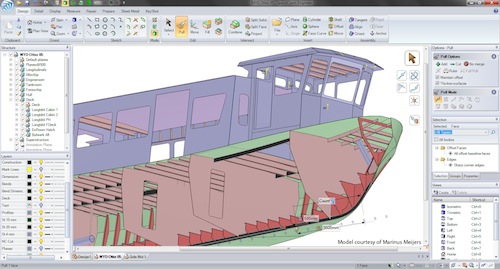 The new capabilities in SpaceClaim 2011 include improved large assembly performance, the ability to model off of imported mesh data, and improved free-form modeling. This ship's initial hull design started in AeroHydro MultiSurf, and the concept was validated and prepared for manufacturing in SpaceClaim. Model courtesy of Marius Meijers. |
"SpaceClaim has experienced a very robust 2010, signing new large enterprise customers as well as international partners such as TRUMPF," says Chris Randles, SpaceClaim president and CEO. "By elevating concept and bid modeling, advancing CAE workflow, and enabling all engineers to communicate in 3D, we're helping our customers converge on key decisions early in the process. SpaceClaim creates a 3D specification that drives detailed design, so engineers can release to CAD when all critical gaps are removed and product success is assured."
New capabilities in SpaceClaim 2011 range from increasingly accessible surfacing, assembly, and model preparation enhancements to strengthened sheet metal and CAD interoperability features. Highlights include:
By communicating in 3D prior to release to CAD, the company says engineers can capture knowledge that drives better design decisions, focus on value and eliminate unnecessary specifications, and move the design to CAD only when success is assured.
For more information, visit SpaceClaim.
Sources: Press materials received from the company and additional information gleaned from the company's website.


DE's editors contribute news and new product announcements to Digital Engineering. Press releases may be sent to them via [email protected].
Follow DE
Join over 90,000 engineering professionals who get fresh engineering news as soon as it is published.






About Us · Contact Us · Editorial Team · Advertising · Privacy Policy · Subscriber Services · © 2026 Digital Engineering 24/7 · Peerless Media