Helping design and engineering professionals discover, evaluate and specify technologies and processes that shorten the design cycle and enable success.



Digital Engineering April 2026
In the latest issue of Digital Engineering, we take a look at the latest innovations in design for additive manufacturing, including the use of natural language inputs, social media cosplayers, and AI integration. The issue also includes a feature…

January Special Focus Issue: Design for Additive
In this Special Focus Issue of Digital Engineering, learn about the latest advancements in design for additive manufacturing, including new software tools, additive in automotive, custom medical devices, and more.
That may be changing. Last year, Rapid Ready covered a startup company by the name of Spectrom. Fresh out of college, developers Cédric Kovacs-Johnson and Charles Haider are attempting to bring full-color 3D printing to an FDM platform. Even better, the company intends for its coloring platform to be compatible with most FDM 3D printers already on the market.
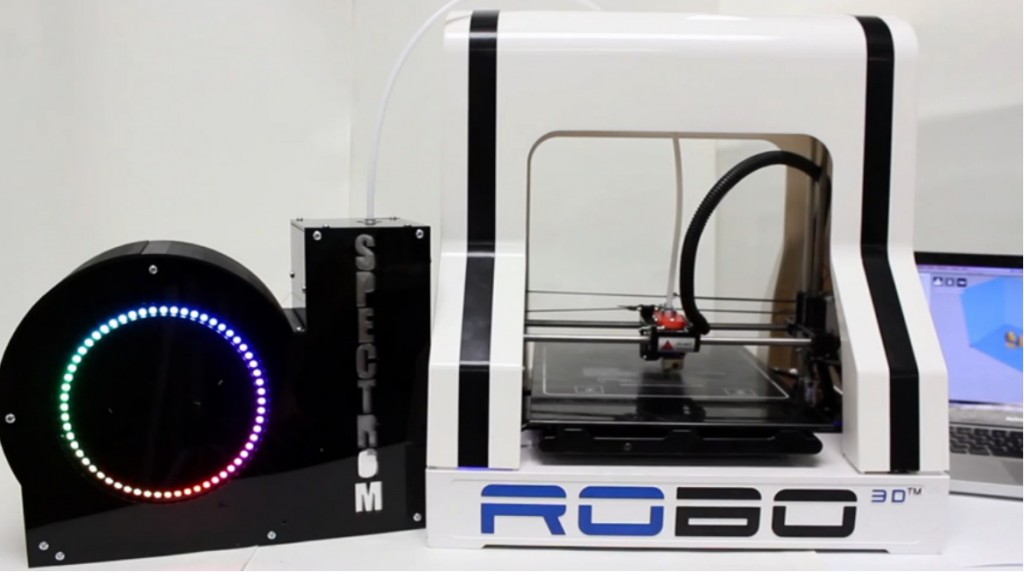 Spectrom's coloring system attached to a Robo printer. Courtesy of Spectrom.
Spectrom’s coloring process uses an algorithm to determine when and where a dye should be added to the filament flow to produce the desired color mix. The filament goes directly from the dying process to the fusing process, where the dye is essentially baked in to place.
Right now, Spectrom is able to produce basic full-color prints, is in the midst of beta testing and showed off its work at CES. The next stage of development for the company is to further refine its coloring algorithm to allow for finer color details. The eventual goal is the ability to color objects down to the voxel (like a pixel, only in 3D), which will offer much finer color control.
Obviously there’s no word on pricing yet for Spectom’s system, but it isn’t very difficult to envision a future where the company’s coloring platform is frequently seen sharing space with FDM 3D printers. I think Spectrom has made a very smart decision to develop a system that is capable of working with existing 3D printers rather than developing a new AM system.
Below you’ll find Spectrom’s short CES intro video.
Source: Spectrom


John Newman is a Digital Engineering contributor who focuses on 3D printing. Contact him via [email protected] and read his posts on Rapid Ready Technology.
Follow DE
Join over 90,000 engineering professionals who get fresh engineering news as soon as it is published.






About Us · Contact Us · Editorial Team · Advertising · Privacy Policy · Subscriber Services · © 2026 Digital Engineering 24/7 · Peerless Media