Helping design and engineering professionals discover, evaluate and specify technologies and processes that shorten the design cycle and enable success.



Digital Engineering April 2026
In the latest issue of Digital Engineering, we take a look at the latest innovations in design for additive manufacturing, including the use of natural language inputs, social media cosplayers, and AI integration. The issue also includes a feature…

January Special Focus Issue: Design for Additive
In this Special Focus Issue of Digital Engineering, learn about the latest advancements in design for additive manufacturing, including new software tools, additive in automotive, custom medical devices, and more.
In theory, AM would be a perfect fit for the fashion industry, offering customers an endless array of unique patterns and designs that could be tailored to individual customers. British company, Tamicare, intends to pull AM textiles down from its lofty fashion perch and offer it to the masses in the form of a 3D printed material the company has named Cosyflex.
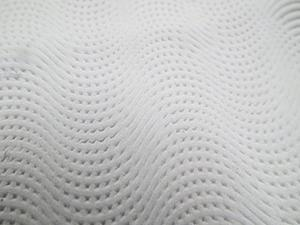
Tamicare describes the material on its website:
Enabling the creation of innovative, all direction-stretchable non-woven fabrics based on the unique integration of elastomers and textile fibers, Cosyflex opens up an entirely new world of possibilities for product developers everywhere. Made primarily of natural, fully biodegradable materials (other materials may be used if required), Cosyflex presents outstanding elongation, recovery and drape, allowing for enormous flexibility and variety.
Cosyflex is manufactured additively, but not in the manner to which you might be accustomed. Instead of an extruder head or print bed, the fabric is built up in layers by a spray jet over the course of a few seconds, rather than minutes or hours. The system is capable of working with liquid polymers such as natural latex, silicon, polyurethane and Teflon, as well as variety of textile fibers such as cotton, viscose and polyamide. Patterns, colors, decorative elements and perforations can all be added during manufacturing.
A largely biodegradable material opens up opportunities for one-off clothes for special occasions, disposable towels, or other unique applications without the usual concerns about waste. One of Tamicare’s first pitches is to the women’s undergarment industry. The company would like to manufacture disposable women’s underwear to be worn during days of heavy menstrual flow that could then be pitched after use. Other potential applications include swimwear, compression bandages, and sportswear.
Below you’ll find a video clip that displays some of the properties of Cosyflex.
Source: Tamicare


John Newman is a Digital Engineering contributor who focuses on 3D printing. Contact him via [email protected] and read his posts on Rapid Ready Technology.
Follow DE
Join over 90,000 engineering professionals who get fresh engineering news as soon as it is published.






About Us · Contact Us · Editorial Team · Advertising · Privacy Policy · Subscriber Services · © 2026 Digital Engineering 24/7 · Peerless Media