Helping design and engineering professionals discover, evaluate and specify technologies and processes that shorten the design cycle and enable success.


Sponsored
 Dear Desktop Engineering Reader:
CFD (computational fluid dynamics) technology for simulating turbomachinery keeps advancing, enabling it to handle more complex problems with greater speed and accuracy. That, in turn, lets you deliver end users more efficient, quiet and reliable products. ANSYS 17.0 incorporates a number of new technologies and enhancements for simulating turbomachinery. Today's Check it Out link takes you to a complimentary on-demand webinar that explains and demonstrates the key new features in ANSYS CFD and ANSYS CFX 17.0 for simulating turbomachinery.
“Three Advanced Technologies for Faster, More Accurate Turbomachinery Simulation” offers a trio of distinct, in-depth engineering presentations. In order, these are: “Turbulence Modeling Advancements for Turbomachinery Flows,” “Combustion Physics” and “Blade Row Methods in ANSYS CFX 17.0.” Each runs 18 or so minutes, and each is loaded with examples, animations and tips for best practices. All are excellent.
Key topics in the first presentation on turbulence modeling of turbomachinery flows include laminar turbulent transition and scale-resolving simulations in ANSYS CFD. The featured part of the presentation focuses on a new one-equation, intermittency-based turbulence transition model that decreases the complexity and solution time of boundary layer simulations by reducing the number of transport equations to be solved from two to one.
At about the 18-minute mark, the webinar turns to combustion physics and the improvements in version 17.0 that increase the accuracy of reacting flows. Among these improvements are new support for an FGM (flamelet generated manifold) model, extensions for soot modeling, Eulerian wall film capabilities and evaporation physics. General improvements covered include scale-resolving turbulence methods for higher fidelity results and improved memory efficiency, data handling speed and robustness in ANSYS Fluent.
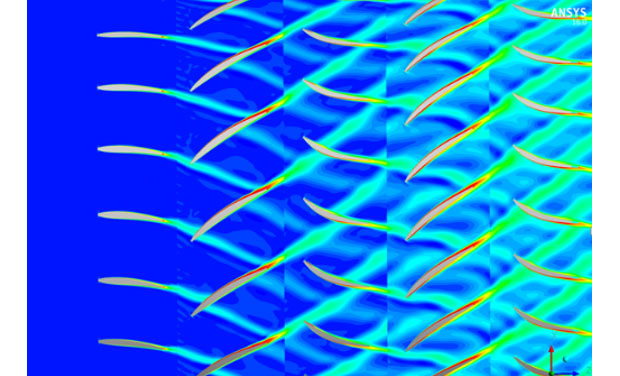
Blade row modeling comes to the fore at around 48 minutes. ANSYS 17.0 extends the available transient methods in ANSYS CFX to include multistage simulation, multi-frequency disturbances and asymmetric geometries, which enable efficient CFD simulation of multistage turbomachinery. Here, a cool demo shows how you can now get a full wheel solution by calculating as few as one blade per row instead of calculating every blade in every row as before.
The individual presentations that make up ANSYS’ “Three Advanced Technologies for Faster, More Accurate Turbomachinery Simulation” webinar are so thorough that they could standalone and satisfy anyone’s need to know. Together, however, they make this a powerful, educational and engaging technical webinar. Hit today's Check It Out link to watch it now. Good stuff.
Thanks, Pal. – Lockwood
Anthony J. Lockwood
Editor at Large, Desktop Engineering
Watch “Three Advanced Technologies for Faster, More Accurate Turbomachinery Simulation” now.


Anthony J. Lockwood is Digital Engineering's founding editor. He is now retired. Contact him via [email protected].
Follow DE
Join over 90,000 engineering professionals who get fresh engineering news as soon as it is published.






About Us · Contact Us · Editorial Team · Advertising · Privacy Policy · Subscriber Services · © 2026 Digital Engineering 24/7 · Peerless Media