Helping design and engineering professionals discover, evaluate and specify technologies and processes that shorten the design cycle and enable success.



Digital Engineering April 2026
In the latest issue of Digital Engineering, we take a look at the latest innovations in design for additive manufacturing, including the use of natural language inputs, social media cosplayers, and AI integration. The issue also includes a feature…

January Special Focus Issue: Design for Additive
In this Special Focus Issue of Digital Engineering, learn about the latest advancements in design for additive manufacturing, including new software tools, additive in automotive, custom medical devices, and more.
Additive manufacturing (AM) is definitely an emerging technology that has the military’s attention. It has multiple potential uses for aviation alone, and the Defense Department is a major investor in President Obama’s plan for a National Network for Manufacturing Innovation. Now, the U.S. Army has made an investment in AM to act in a support capacity for troops on the ground.
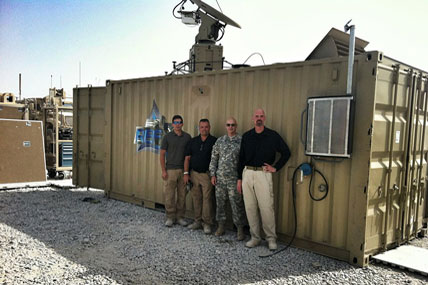
The Army’s Rapid Equipping Force (REF) is responsible for providing quick solutions to specific problems for soldiers in the field. In theaters like Afghanistan where a forward operating base can be set up almost literally in the middle of nowhere, the REF mission is vital to operations. The newest addition to the REF toolset is the Expeditionary Lab – Mobile.
The Expeditionary Lab – Mobile includes fairly standard workshop equipment such as plasma cutters, welders, magnetic mounted drill-presses, electric hacksaws, routers, circular saws and jig saws. The lab also boasts more high-tech equipment in the form of a CNC machine and a 3D printer, along with engineers to operate the machinery.
“The soldiers out there, they know how to do stuff; they know how to fix stuff and they know what they need to be able to do, but what they don’t have is the technical expertise in many cases to do it themselves,” said Col. Pete Newell, commander of the Army’s Rapid Equipping Force at Fort Belvoir, Va.
“It’s really difficult to connect the guy who is building the product to the kid who really needed it to begin with, so what we went after is to connect the scientist to the soldier,” said Newell. “Rather than bringing the soldier home to the scientist, we have uprooted the scientist and the engineer and brought them to the soldier.”
Each lab is housed in a 20 ft. shipping container with workstations that can be rolled out. The lab also contains satellite communications equipment to allow the scientists in the field to communicate with REF officials and engineers off-site, bringing more know-how to the operation without adding to personnel on the ground. In addition, each lab comes complete with an electricity generator and air conditioning/heating system.
The Expeditionary Lab – Mobile cost around $2.8 million to build. The first one was deployed at Regional Command South near Kandahar. Other labs are being constructed, with one intended to remain in reserve to assist with future disaster relief efforts.
Below you’ll find an REF video about the new labs.
Source: Military.com


John Newman is a Digital Engineering contributor who focuses on 3D printing. Contact him via [email protected] and read his posts on Rapid Ready Technology.
Follow DE
Join over 90,000 engineering professionals who get fresh engineering news as soon as it is published.






About Us · Contact Us · Editorial Team · Advertising · Privacy Policy · Subscriber Services · © 2026 Digital Engineering 24/7 · Peerless Media