Helping design and engineering professionals discover, evaluate and specify technologies and processes that shorten the design cycle and enable success.




Digital Engineering April 2026
In the latest issue of Digital Engineering, we take a look at the latest innovations in design for additive manufacturing, including the use of natural language inputs, social media cosplayers, and AI integration. The issue also includes a feature…

January Special Focus Issue: Design for Additive
In this Special Focus Issue of Digital Engineering, learn about the latest advancements in design for additive manufacturing, including new software tools, additive in automotive, custom medical devices, and more.
Researchers at the University of Illinois at Urbana-Champaign are using 3D printing to create what they call “bio bots.” Generally, when people think of robots, they envision machines built from materials such as hard plastic or metals. Those kinds of materials are hardly ideal for certain applications, however, such as diving into the bloodstream of a patient.
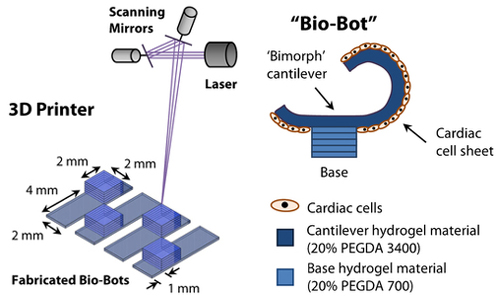
“As engineers, we’ve always built things with hard materials, materials that are very predictable, said Rashid Bashir, an Abel Bliss Professor of Engineering. Yet there are a lot of applications where nature solves a problem in such an elegant way. Can we replicate some of that if we can understand how to put things together with cells?”
Bashir’s team used a HeCd laser and galvanometer scanning mirrors to build a stereolithography 3D printer. As one would expect with AM, each bot was built a layer at a time. The first layer to be completed consisted of soft cantilever hyrdrogel, followed by a more rigid hydrogel precursor solution. Next came the biological “motor” for the bots. From the published research paper:
Cardiomyocytes derived from neonatal rat hearts were extracted and seeded onto the cantilevers. The cardiomyocytes attached to the cantilevers, increased in size, and exhibited spontaneous contractile activity. Over several days, they produced a confluent culture and formed a cardiac cell sheet that contracted in synchrony.
The end result was a series of bio bots measuring between 5 to 10 mm. The slow beating of the bio motor allowed the bots to move forward with at a max speed of


John Newman is a Digital Engineering contributor who focuses on 3D printing. Contact him via [email protected] and read his posts on Rapid Ready Technology.
Follow DE
Join over 90,000 engineering professionals who get fresh engineering news as soon as it is published.






About Us · Contact Us · Editorial Team · Advertising · Privacy Policy · Subscriber Services · © 2026 Digital Engineering 24/7 · Peerless Media