Helping design and engineering professionals discover, evaluate and specify technologies and processes that shorten the design cycle and enable success.



Digital Engineering April 2026
In the latest issue of Digital Engineering, we take a look at the latest innovations in design for additive manufacturing, including the use of natural language inputs, social media cosplayers, and AI integration. The issue also includes a feature…

January Special Focus Issue: Design for Additive
In this Special Focus Issue of Digital Engineering, learn about the latest advancements in design for additive manufacturing, including new software tools, additive in automotive, custom medical devices, and more.
The US military is no exception to this trend. The Army already has rapid deployment centers in the field that feature 3D printers, and the Navy is investigating the potential uses of an AM system onboard its ships. Now, the Army is expanding the reach of AM by adding the technology to the U.S. Army Aviation and Missile Research Development and Engineering Center (AMRDEC).
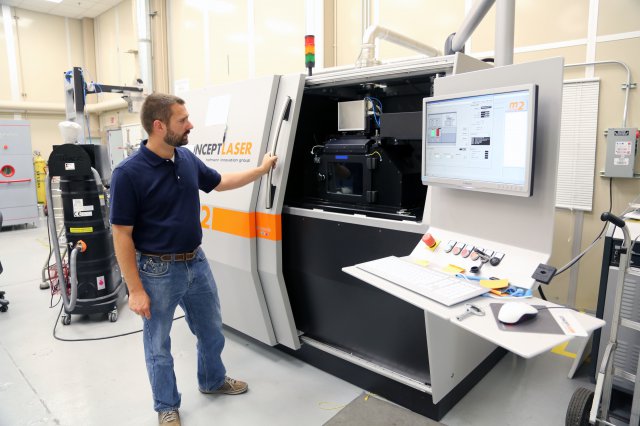 AMRDEC engineer on assignment learning about 3D printing at the Additive Manufacturing Lab at NASA's Marshall Space Flight Center. Courtesy the US Army.
A collaborative effort among AMRDEC, NASA's Marshall Space Flight Center, and the University of Alabama in Huntsville is investigating how AM can be used to improve and expedite missile design. This includes cost-saving measures, optimized performance of missile structures, using topology optimization routines to improve the design and analysis of AM built structures, and documenting which materials and processes offer the best solutions for specific missile applications.
“When you come to learn and appreciate the potential of AM, it's hard not to judge this as a true game-changer; one that will ultimately have far reaching, historical impacts onto our society at-large,” said acting AMRDEC director James Lackey. “Teaming with NASA MSFC and other partners, AMRDEC will investigate procurements of AM machines to support our research needs, build a cadre of engineers and scientists savvy on this technology, fabricate and performance test qualify components for ground and flight test.”
Defense is one area President Obama had in mind when he pushed for the founding of advanced manufacturing innovation institutes around the country. While this program is specifically attached to one of the institutes, AMRDEC will still benefit from the accumulation of knowledge produced by the pilot institute up and running in Youngstown, OH.
Below you’ll find a short video about how the US Army is already putting AM to work.
Source: US Army


John Newman is a Digital Engineering contributor who focuses on 3D printing. Contact him via [email protected] and read his posts on Rapid Ready Technology.
Follow DE
Join over 90,000 engineering professionals who get fresh engineering news as soon as it is published.






About Us · Contact Us · Editorial Team · Advertising · Privacy Policy · Subscriber Services · © 2026 Digital Engineering 24/7 · Peerless Media