Helping design and engineering professionals discover, evaluate and specify technologies and processes that shorten the design cycle and enable success.




Digital Engineering April 2026
In the latest issue of Digital Engineering, we take a look at the latest innovations in design for additive manufacturing, including the use of natural language inputs, social media cosplayers, and AI integration. The issue also includes a feature…

January Special Focus Issue: Design for Additive
In this Special Focus Issue of Digital Engineering, learn about the latest advancements in design for additive manufacturing, including new software tools, additive in automotive, custom medical devices, and more.
One of the complaints surrounding additive manufacturing (AM) is its speed. While 3D printers are great at turning around a low volume of complex parts more quickly than through traditional manufacturing methods, AM has yet to match the speed of production offered by injection molding or stamp presses. Researchers at the USC Viterbi School of Engineering have developed a new process for AM that has the potential to reduce the time for a print from hours to minutes.
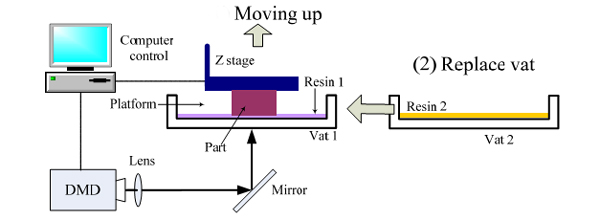
Under the direction of Yong Chen, professor in the Daniel J. Epstein Department of Industrial and Systems Engineering, research into speeding up AM has focused on a process called mask-image-projection-based stereolithography (MIP-SL). Mask projection AM isn’t a new idea. The process uses a digital micromirror device, light source, and lens to project an image into photocurable resin. The resin hardens in thin layers in the shape of the image projected, slowly building an entire object.
Because mask projection targets entire areas simultaneously, rather than single points as is the case in laser-based AM, the build time of objects is reduced. The problem with mask projection is it requires deep vats of expensive photocurable resin in which to build objects, the majority of which is wasted. A single print pollutes the resin not used to build an object, making mask projection a less appealing process from a financial point of view, regardless of potential gains in print times.
Chen and his team have cleaned up the process by literally flipping it on its head. Instead of projecting an image from above, the image is projected from below, reducing the amount of resin used. A resin vat only needs to hold as much resin as is necessary to build a layer as it builds from the bottom up. Chen’s first experiments with bottom up MIP-SL focused on a single material, but his team has recently made a breakthrough in producing multi-material objects using the same process.
“Digital material design and fabrication enables controlled material distributions of multiple base materials in a product component for significantly improved design performance,” said Chen. “Such fabrication capability opens up exciting new options that were previously impossible.”
This improved process allows for single and multi-material objects to be built over the course of a few minutes, rather than requiring several hours, without the massive, and expensive, waste generally associated with MIP-SL. Improvements aside, work remains to be done on developing means for computers to accurately communicate 3D designs to the MIP-SL process. When that last hurdle is crossed, 3D printing will move to speeds never before imagined for the technology.
Below you’ll find a video featuring Yong Chen speaking about his research.
Source: USC


John Newman is a Digital Engineering contributor who focuses on 3D printing. Contact him via [email protected] and read his posts on Rapid Ready Technology.
Follow DE
Join over 90,000 engineering professionals who get fresh engineering news as soon as it is published.






About Us · Contact Us · Editorial Team · Advertising · Privacy Policy · Subscriber Services · © 2026 Digital Engineering 24/7 · Peerless Media