Helping design and engineering professionals discover, evaluate and specify technologies and processes that shorten the design cycle and enable success.



Digital Engineering April 2026
In the latest issue of Digital Engineering, we take a look at the latest innovations in design for additive manufacturing, including the use of natural language inputs, social media cosplayers, and AI integration. The issue also includes a feature…

January Special Focus Issue: Design for Additive
In this Special Focus Issue of Digital Engineering, learn about the latest advancements in design for additive manufacturing, including new software tools, additive in automotive, custom medical devices, and more.
University of Texas at Dallas (UT Dallas) researchers have designed and 3D-printed a ventilator part and are working to manufacture testing swabs and personal protective equipment (PPE) in a campus lab mobilized to address potential supply shortages due to the COVID-19 pandemic.
Positive end-expiratory pressure, or PEEP, valves are disposable parts used with ventilators to ensure that patients’ lungs retain some air and do not collapse when exhaling. A new valve is needed for each patient. The UT Dallas team is seeking emergency approval from the U.S. Food and Drug Administration so it can distribute the parts to hospitals that need the device.
The team began developing the PEEP valves in March to be proactive and address concerns about current and future shortages of ventilators during rapidly changing circumstances.
“We’re excited to be able to use 3D-printing technology to manufacture equipment that could save the lives of COVID-19 patients and protect the health care workers caring for them,” says Dr. Walter Voit BS’05, MS’06, associate professor of materials science and engineering and mechanical engineering in the Erik Jonsson School of Engineering and Computer Science. Voit, the principal investigator who runs the Advanced Polymer Research Lab, is one of the faculty members leading the effort. He also is founder and CEO of Adaptive 3D Technologies, a company launched through the UT Dallas Venture Development Center, which supplied the rubber used in the inner component and the outer casing in some of the valves.
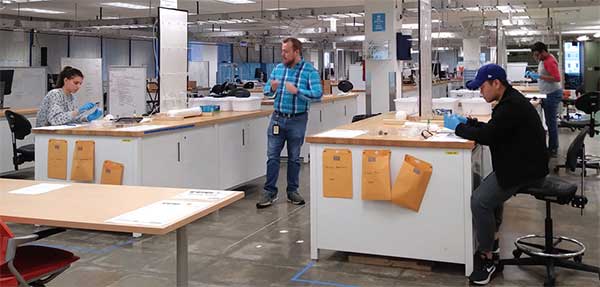
The University mobilized the COVID-UT Dallas Response Lab (CURL) in the UTDesign Studio, which typically is used by engineering students working on senior capstone projects. The studio was closed when, in response to the pandemic, the University limited campus access to essential personnel only and moved classes online. The UT Dallas 3D-printing team is one of several university groups across the country operating through 3D Corps, an informal collaboration of experts, to increase the supply of ventilators and protective equipment.
Khoa Nguyen, who volunteered to work in the lab, assembles a 3D-printed diaphragm into a 3D-printed PEEP valve case. “Working in the lab gave me a sense of purpose and fulfillment knowing that I’m contributing to our fight against COVID-19 no matter how small or large it might be,” Nguyen says.
“We’re grateful to The University of Texas System for authorizing us to open the UTDesign lab during the COVID-19 pandemic so we could rapidly mobilize an incredible team of faculty and student researchers to use their expertise to help fill critical shortages in lifesaving equipment at hospitals,” says Dr. Stephanie G. Adams, dean of the Jonsson School and Lars Magnus Ericsson Chair.
Key participants in UT Dallas’ effort, in addition to Voit, include Dr. Ronald Smaldone, associate professor of chemistry in the School of Natural Sciences and Mathematics, and Dr. Hongbing Lu, Louis Beecherl Jr. Chair and professor of mechanical engineering, as well as other faculty and graduate students who volunteered to work on the project.
Researchers 3D-printed PEEP valves at the UT Dallas lab. The team is seeking approval from the U.S. Food and Drug Administration so it can distribute the parts to hospitals.
The researchers worked closely with UT Southwestern Medical Center physicians to determine the most urgent needs. Dr. Hongzhao Ji, assistant professor of otolaryngology-head and neck surgery at UT Southwestern, said that although the hospital has PEEP valves on hand and more on back order, the 3D-printing project will help ensure that an adequate supply is available if needed.
“In the end, it would be great if we never actually needed any of this,” Ji says. “If it turns out we do need them, it’ll be great to have some solutions.”
The CURL researchers also are working on several other projects, which they hope to provide in the coming weeks:
Modeling, designing, manufacturing, testing and distributing the equipment requires a range of expertise from UT Dallas team members, along with sophisticated imaging and printing equipment. The trial and error and rigorous testing illustrates how the engineering and innovation process works.
After receiving an existing PEEP valve from Ji, UT Dallas researchers captured images of the device using a CT scan in Lu’s Mechanics of Advanced Materials Laboratory. Researchers in the lab focus on understanding the mechanical behavior of polymers and their composites under blunt impact and fatigue-loading conditions. The lab’s CT scan can penetrate 2-in. metals and other materials and generate high-resolution 3D images needed to design and reverse-engineer medical components. PEEP valves consist of a thin rubber component inside a hard plastic tube. The valve opens and closes to control a patient’s air flow.
From there, researchers converted images into computer-aided design files, which were used to print the parts on 3D printers. Dr. Robert Hart, mechanical engineering UTDesign Capstone faculty director, and Bill Krenik PhD’93, chief technology officer of custom products at Texas Instruments Inc., who serves on the University’s Executive Board, developed the testing rig for the valves. The first couple of attempts failed rigorous testing, but by improving the sealing capability, the researchers attained a successful design. Several private companies will manufacture large quantities of the valves.
Dr. Robert Hart, clinical associate professor of mechanical engineering in the Erik Jonsson School of Engineering and Computer Science, stands next to his PEEP valve testing rig.
The team anticipates being able to manufacture hundreds of PEEP valves initially and tens of thousands in the coming months should they be needed.
The PEEP valve initiative received support from hospitals and corporate partners, including UT Southwestern, Parkland Health & Hospital System, Texas Instruments and Unique Software Development.
Sources: Press materials received from the company and additional information gleaned from the company’s website.


DE's editors contribute news and new product announcements to Digital Engineering. Press releases may be sent to them via [email protected].
Follow DE
Join over 90,000 engineering professionals who get fresh engineering news as soon as it is published.






About Us · Contact Us · Editorial Team · Advertising · Privacy Policy · Subscriber Services · © 2026 Digital Engineering 24/7 · Peerless Media