Helping design and engineering professionals discover, evaluate and specify technologies and processes that shorten the design cycle and enable success.



Digital Engineering April 2026
In the latest issue of Digital Engineering, we take a look at the latest innovations in design for additive manufacturing, including the use of natural language inputs, social media cosplayers, and AI integration. The issue also includes a feature…

January Special Focus Issue: Design for Additive
In this Special Focus Issue of Digital Engineering, learn about the latest advancements in design for additive manufacturing, including new software tools, additive in automotive, custom medical devices, and more.
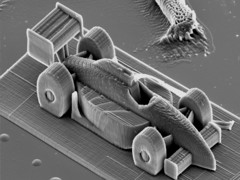
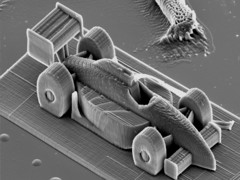
Much of the 3D printing tech we look at here is at least partially judged by the available build envelope. The ability to print bigger objects is usually a plus, as is the case with the South African additive manufacturing facility under construction.
Occasionally though, smaller can be better. When it comes to potential breakthroughs in medical technology, size isn’t everything. Having an envelope large enough to print a jawbone is fantastic, but so is a printer able to build objects on the nano scale.
Vienna University has created a 3D printer using what they call "two-photon lithography" that is able to build objects with nanometer thick layers. The process uses mirrors to produce narrow focus laser that builds layers of liquid resin. Researchers gave the process its name because the resin must be able to absorb a minimum of two photons in order to set. This particular process also allows layers to be built without having to cure to topmost layer, which speeds up the build.
Until now, this technique used to be quite slow. The printing speed used to be measured in millimeters per second – our device can do five meters in one second. –Professor Jürgen Stampfl, TU Vienna Institute of Materials Science and Technology
With the new speed record in hand, researchers at Vienna University are working on developing bio-compatible resins for medical applications. Potential applications include using the process to create scaffolds for living cells to latch onto, speeding up the creation of biological tissue. Because the laser used in the process is so narrow, scientists are able to work in and around the cells without harming them, something other processes can’t match.
"We can also 'write' these structures in the presence of cells as we use an infrared laser, which is completely harmless for biological tissue," said Professor Stampfl. “The two-photon lithography technique lets us do the writing in the same space as the cells — what we call in-vivo writing."
Below you’ll find a video of the process in action.
Sources: Vienna University, BBC


John Newman is a Digital Engineering contributor who focuses on 3D printing. Contact him via [email protected] and read his posts on Rapid Ready Technology.
Follow DE
Join over 90,000 engineering professionals who get fresh engineering news as soon as it is published.






About Us · Contact Us · Editorial Team · Advertising · Privacy Policy · Subscriber Services · © 2026 Digital Engineering 24/7 · Peerless Media