Helping design and engineering professionals discover, evaluate and specify technologies and processes that shorten the design cycle and enable success.



Digital Engineering April 2026
In the latest issue of Digital Engineering, we take a look at the latest innovations in design for additive manufacturing, including the use of natural language inputs, social media cosplayers, and AI integration. The issue also includes a feature…

January Special Focus Issue: Design for Additive
In this Special Focus Issue of Digital Engineering, learn about the latest advancements in design for additive manufacturing, including new software tools, additive in automotive, custom medical devices, and more.
Weber State University (WSU) is using 3D printing to advance its research on composite materials that support northern Utah's aerospace and defense ecosystem.
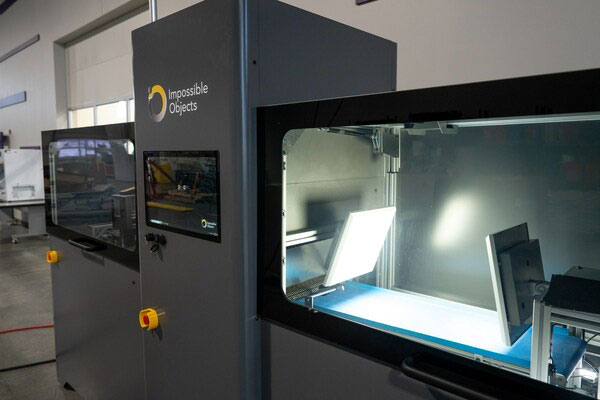
The university's Miller Advanced Research and Solutions Center recently upgraded and installed the Impossible Objects Composite-Based Additive Manufacturing system, or CBAM-2. The machine prints composite materials that can be used to design parts for a range of high-tech applications.
Located near Hill Air Force Base, UT, the MARS Center brings together Weber State students and faculty with industry experts who can apply solutions to real-world problems, especially in national defense.
"Composite materials are of high interest to the military, and the ability to 3D print those parts on demand with CBAM gives us an advantage to participate in more projects and recruit the best talent," says David Ferro, dean of WSU's College of Engineering, Applied Science & Technology.
Ferro says Weber State has a history with Impossible Objects and believes the new system—advanced in technology from the center's previous CBAM printer—will be a vtool in aerospace research among academia, defense and commercial partners.
"We've used this technology to print parts for legacy aircraft, aging jets that need replacement parts or tools that aren't in production anymore," says Devin Young, grant writing and research specialist at WSU, who works at the MARS Center. "CBAM makes parts that are lighter and stronger than some of the other methods out there, and it does it faster."
Steve Hoover, Impossible Objects CEO, says the CBAM system's Carbon Fiber PEEK 3D printed material achieves excellent mechanical properties and is an alternative for aluminum prototyping, tooling, spares and repairs.
"The MARS Center is at the forefront of aerospace and defense research," Hoover says. "We're proud that they've selected CBAM technology, and have already engaged in several projects that have exciting potential for the Department of Defense, Department of Energy and other industrial partners."
The MARS Center opened in August 2022 thanks to a $3.5 million donation from the Larry H. & Gail Miller Family Foundation. The CBAM 3D Printer from Impossible Objects is among the first advanced manufacturing technologies to be installed and used at the new facility.
Sources: Press materials received from the company and additional information gleaned from the company’s website.


DE's editors contribute news and new product announcements to Digital Engineering. Press releases may be sent to them via [email protected].
Follow DE
Join over 90,000 engineering professionals who get fresh engineering news as soon as it is published.






About Us · Contact Us · Editorial Team · Advertising · Privacy Policy · Subscriber Services · © 2026 Digital Engineering 24/7 · Peerless Media