Helping design and engineering professionals discover, evaluate and specify technologies and processes that shorten the design cycle and enable success.



Digital Engineering April 2026
In the latest issue of Digital Engineering, we take a look at the latest innovations in design for additive manufacturing, including the use of natural language inputs, social media cosplayers, and AI integration. The issue also includes a feature…

January Special Focus Issue: Design for Additive
In this Special Focus Issue of Digital Engineering, learn about the latest advancements in design for additive manufacturing, including new software tools, additive in automotive, custom medical devices, and more.
One of the great leaps in cinema was the transition from black-and-white movies to color. That isn’t to say truly great movies weren’t made in black-and-white (I’m looking at you Citizen Kane), but the move to color made the movie-going experience all that more engrossing. Color can perform similar work in additive manufacturing (AM) by driving the imagination further, and offering a wider pallete of possibilities.
Cédric Kovacs-Johnson and Charles Haider, both chemical engineering students at the University of Wisconsin-Madison (UW), have developed a means of adding color to material extrusion process (called Fused Deposition Modeling by Stratasys) AM systems during the course of a print. This opens up a number of opportunities for future development that go beyond the somewhat clunky mechanics of dual-head extruders.
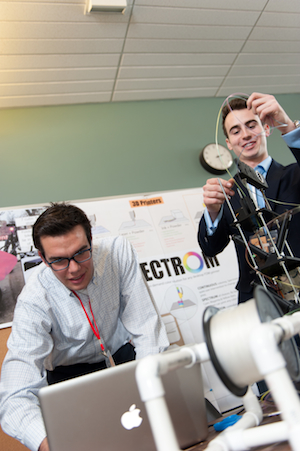
Kovacs-Johnson and Haider developed the color additive process, which they call Spectrom, for the 20th annual Innovation Days at UW. Their work won both the $10,000 Schoofs Prize for Creativity and the $2,500 Tong Prototype Prize. The duo chose the material extrusion process for their research because it is the most commonly used and available 3D printing process currently available.
Spectrom is an adaptor for material extrusion printers that works by adding a dye to standard transparent plastic filament during a print’s build. The adaptor is meant to be able to fit nearly any type of material extrusion system, and brings a versatility to the process that was previously lacking.
Kovacs-Johnson and Haider see a number of potential applications for the Spectrom, including matching skin color for prosthetics or using the Specrtom’s coloring power to draw attention to specific features of prototypes.
“One of the things when you’re doing prototyping is that you’re looking to highlight specific, complex features,” said Haider. “Being able to bring clarity to the parts that are unique—while in meetings with clients and upper-level management—that’s where we have an advantage.”
At this point you can find a number of multiple color or full-color AM systems on the market. If Kovacs-Johnson and Haider can manage to bring their product to market, they have an opportunity to fill a low-priced gap in color material extrusion systems.
Below you’ll find a video that explains the material extrusion process.
Source: University of Wisconsin-Madison


John Newman is a Digital Engineering contributor who focuses on 3D printing. Contact him via [email protected] and read his posts on Rapid Ready Technology.
Follow DE
Join over 90,000 engineering professionals who get fresh engineering news as soon as it is published.






About Us · Contact Us · Editorial Team · Advertising · Privacy Policy · Subscriber Services · © 2026 Digital Engineering 24/7 · Peerless Media