Helping design and engineering professionals discover, evaluate and specify technologies and processes that shorten the design cycle and enable success.



Digital Engineering April 2026
In the latest issue of Digital Engineering, we take a look at the latest innovations in design for additive manufacturing, including the use of natural language inputs, social media cosplayers, and AI integration. The issue also includes a feature…

January Special Focus Issue: Design for Additive
In this Special Focus Issue of Digital Engineering, learn about the latest advancements in design for additive manufacturing, including new software tools, additive in automotive, custom medical devices, and more.
Taiwan’s XYZ Printing may not be able to help you with developing your own digital designs, but the company’s new AM system is capable of assisting you with digital scans. Named the da Vinci 1.0AiO, the new system combines a scanner and a 3D printer that both share the same rotating build table.
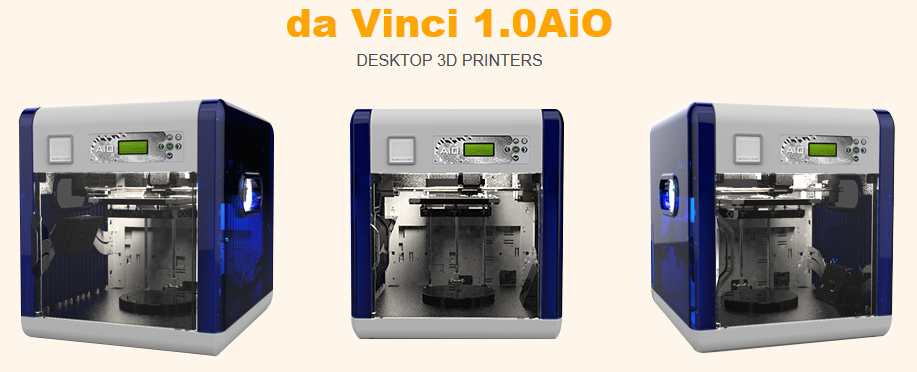 XYZ Printing's new system combines scanning and 3D printing into one machine. Courtesy of XYZ Printing.
The scanning half of the systems uses slit laser triangulation, capable of scanning a 15 x 15 cm object, with a scan accuracy of 0.25 mm, and a scan resolution of 0.25 mm. What do those specs mean? They mean don’t expect super detailed digital models, but the system is still usable for objects that require less detail.
The 3D printer side of the system uses a Fused Filament Fabrication (essentially Fused Deposition Modeling) process. Other specs are similar to the original da Vinci system, and are as follows:
Below you’ll find a video about the new all-in-one AM and scanning system.
Source: XYZ Printing


John Newman is a Digital Engineering contributor who focuses on 3D printing. Contact him via [email protected] and read his posts on Rapid Ready Technology.
Follow DE
Join over 90,000 engineering professionals who get fresh engineering news as soon as it is published.






About Us · Contact Us · Editorial Team · Advertising · Privacy Policy · Subscriber Services · © 2026 Digital Engineering 24/7 · Peerless Media