Helping design and engineering professionals discover, evaluate and specify technologies and processes that shorten the design cycle and enable success.



Digital Engineering April 2026
In the latest issue of Digital Engineering, we take a look at the latest innovations in design for additive manufacturing, including the use of natural language inputs, social media cosplayers, and AI integration. The issue also includes a feature…

January Special Focus Issue: Design for Additive
In this Special Focus Issue of Digital Engineering, learn about the latest advancements in design for additive manufacturing, including new software tools, additive in automotive, custom medical devices, and more.
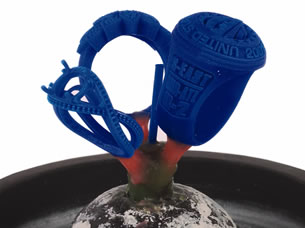 |
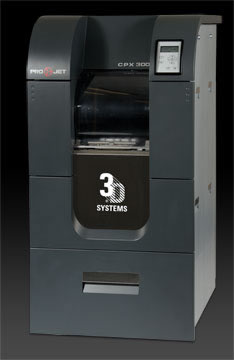
3D Systems Corporation (Rock Hill, SC), a provider of 3D modeling, rapid prototyping (RP), and manufacturing solutions, introduced the ProJet CPX 3000 3D digital printing system, a new high-definition 3D printer designed for creating high-volume, finely detailed wax patterns using digital data. The ProJet CPX 3000 is one of six new 3D printers that will be demonstrated at the company’s upcoming 3D Systems World Conference to be held in Charlotte,NC, from October 20 to 23.
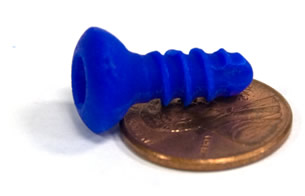
The ProJet CPX 3000 was built for office environments with a 29 in. x 49.5 in. footprint (uncrated); it works with 3D Systems’ patented Multi-Jet Modeling (MJM) technology, and uses two new materials, both of which are wax. The new VisiJet CPX200 is the nontoxic wax build material — a dark blue color wax material that is developed specifically for high-quality casting patterns — and the new VisiJet S200, also nontoxic, is the wax support material that offers dissolvable hands-free removal.
| “We are delighted to deliver a true, fast, 100 percent wax-based investment casting solution, ideal for foundry and other industry segments that addresses all of the required professional casting requirements.” — Buddy Byrum, 3D Systems, senior director of 3-D Printing solutions |
The range of applications for the ProJet 3-D Production System include concept development, design validation, form and fit analysis, molding and casting patterns, direct investment casting of jewelry, and other fine feature applications.
A Professional Precision Investment Casting Tool
The ProJet CPX 3000 3D Printer weighs 560 lbs. uncrated and includes ProJet Accelerator software that facilitates build job setup, submission, and job queue management; automatic part placement and build optimization tools; part stacking and nesting capability; extensive part file editing tools; automatic support generation; and job statistics reporting tools.
 The printer is network-ready with 10/100 Ethernet interface. The client hardware recommendation calls for a 1.8GHz workstation with 1GB RAM (OpenGL support 64Mb video RAM) or higher. It runs on Windows XP Professional and supports STL and SLC for input data file formats. Its operating temperature range is 18-28 degrees C (64-82 degrees F) and the noise it generates at a medium fan setting is estimated at < 65 dBa. The ProJet CPX 3000 is CE certified.
“We are very pleased to be the first to offer a professional precision investment casting tool,” said Buddy Byrum, 3D Systems’ senior director of 3-D Printing solutions at 3D Systems. “We are delighted to deliver a true, fast, 100 percent wax-based investment casting solution, ideal for foundry and other industry segments that addresses all of the required professional casting requirements and is packed with real cost savings.”
RP&M System Both Accurate & Environmentally Friendly
The two build modes are high-definition (HD) for high-speed, detailed production of small to large parts with excellent surface finish that prints 40-micron layers, and an “extreme” high-definition (XHD) mode that prints 16-micron layers for production parts with the more detailed features common in many micro-casting applications. Accuracy detail is said to range from between 0.001 to 0.002 in. (0.025-0.05mm) per inch of part dimension.
 |
According to 3D Systems, the ProJet CPX 3000 was designed for volume production and provides for part nesting and stacking to make use of the entire build volume for long-run, unattended operation. It is the first all-wax 3D printer with stacking capabilities and its proprietary single-pass print-head design facilitates the building of multiple parts at the same time without sacrificing build time. In HD mode, the total build volume is 298 x 185 x 203mm (11.75 x 7.3 x 8 in.); in XHD mode, it is 127 x 178 x 152mm (5 x 7 x 6 in.).
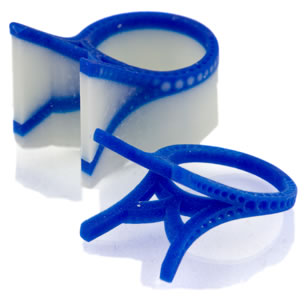
Once the build process is complete, the nontoxic dark-blue build material — and its supporting VisiLet S200 wax support material — can be safely handled and transferred to a dissolve basin where the support material can be removed using isopropyl alcohol. While the wax build material and wax support material are environmentally friendly and do not need special disposal, the dissolve material must be disposed of according to local requirements.
It is said that dissolving the support wax is the only postprocessing needed as the surfaces of the remaining 100 percent “RealWax” pattern are smooth and do not require finishing. The patterns will perform like injected wax patterns in lost-wax casting processes and are suitable for direct investment casting applications using standard investment materials and casting procedures.
Uses & Benefits of AF
According to 3D Systems, the ProJet CPX 3000 system is the only currently available additive fabrication (AF) system capable of producing such detailed 100 percent wax patterns at the speeds it reaches.
 |
It is expected that the new system will appeal to designers and manufacturers of wax patterns for highly complex geometric shapes, jewelry, apparel, medical instruments and devices, mechanical parts, and collectibles.
The company lists the benefits of the standard casting processes and procedures as including smooth surfaces and a fine-feature detail for the above-mentioned micro-casting applications, best-in-class production speed and capacity, quick and easy support-removal leaving smooth support side surfaces, high-volume utilization of entire build volume for longer-run unattended operation, and easy build submission and job queue management.
3D Systems plans to start shipping the ProJet CPX 3000 System during the fourth quarter of this year.
Margaret S. Gurney is the editor for new products at Desktop Engineering magazine.
For more information on this RPM system, please visit 3D Systems.
Read why DE editors chose this as an Editor’s Pick of the Week.
Learn, explore, and network at the 3D Systems World Conference.
Link directly to 3D Systems' web page focused on the ProJet CPX.
Download3D Systems' leaflet with descriptions and tech specs on the ProJet CPX.
To field an inquiry with the company about pricing and other queries, go to the Request for Information form.
For Preferred Service Providers, go to 3D Systems.


DE's editors contribute news and new product announcements to Digital Engineering. Press releases may be sent to them via [email protected].
Follow DE
Join over 90,000 engineering professionals who get fresh engineering news as soon as it is published.






About Us · Contact Us · Editorial Team · Advertising · Privacy Policy · Subscriber Services · © 2026 Digital Engineering 24/7 · Peerless Media