Helping design and engineering professionals discover, evaluate and specify technologies and processes that shorten the design cycle and enable success.


Sponsored

May 2026 Special Focus: Artificial Intelligence in Design and Simulation
In this Special Focus Issue, learn about the latest developments in the integration of artificial intelligence into engineering workflows.

Design & Simulation Software Guide 2025
In this Special Issue, Digital Engineering presents its second annual guide to design and simulation software vendors.
Dear Desktop Engineering Reader:
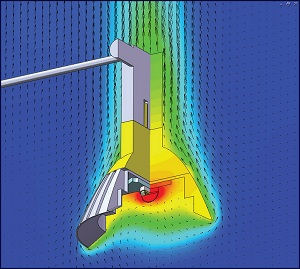 I just finished reading a short white paper on leveraging CAD-embedded computational fluid dynamics (CFD) analysis for luminaire design and optimization, and I did not cringe whenever I hit the L-word -- luminaire. I’ve had a screw loose about “luminaire” since an elderly, tipsy, and gesticulating aunt screeched in her New York accent “lou-mean-ear” 8,000 times while regaling me with a baffling tale about Sid Caesar when I was 8. Anyway, I rather enjoyed this paper, and believe you will too.
“Thermal Simulation Simplifies LED Luminaire Development” is a down-to-Earth 6-page PDF created by Dr. John Parry at Mentor Graphics. The plot line is this: When you design an LED luminaire, you encounter different heat problems than you meet with incandescent and fluorescent luminaires and there’s less of a knowledge base to draw on. In particular, you have to move heat from the device’s p-n junction to the surrounding environment efficiently to mitigate heat build-up that can cause color shifting and lousy light output. So the LED, its printed circuit board mount, the housing, shrouds, and slots have to work together to move the heat out and way -- a model problem for CFD analysis.
The solution demonstrated here uses FloEFD CFD from Mentor Graphics embedded in Pro/ENGINEER (Creo), although most any mainstream MCAD system could have been used. FloEFD leverages the company’s Concurrent CFD technology to automate the tough parts of preparing and running a simulation. The point is to show you that CAD-embedded Concurrent CFD technology enables mechanical and design engineers to develop models, test, and ultimately optimize the heat dispersion properties of a tricky design job like an LED luminaire within their MCAD environment and without pestering a CFD whiz for help.
The paper does an interesting and convincing job of this without hitting you over the head with marketing embellishment. I’ll add that there’s nothing terribly mind-boggling in terms of CFD patois here to slow you down. But that’s also the point since FloEFD is intended for the CAD savvy who are CFD literate but not a CFD hotshot.
“Thermal Simulation Simplifies LED Luminaire Development” is well illustrated as well as eminently readable. It’s the kind of paper that you might slide over to the person blocking your new tools requests out of their, um, misperceptions over what you could do if properly empowered. This is a paper that could make the “oh, I see” light go off over the heads of a lot of people. Hit the link and see the light yourself.
Thanks, Pal. -- Lockwood
Anthony J. Lockwood
Editor at Large, Desktop Engineering


Anthony J. Lockwood is Digital Engineering's founding editor. He is now retired. Contact him via [email protected].
Follow DE
Join over 90,000 engineering professionals who get fresh engineering news as soon as it is published.






About Us · Contact Us · Editorial Team · Advertising · Privacy Policy · Subscriber Services · © 2026 Digital Engineering 24/7 · Peerless Media