Helping design and engineering professionals discover, evaluate and specify technologies and processes that shorten the design cycle and enable success.


Sponsored
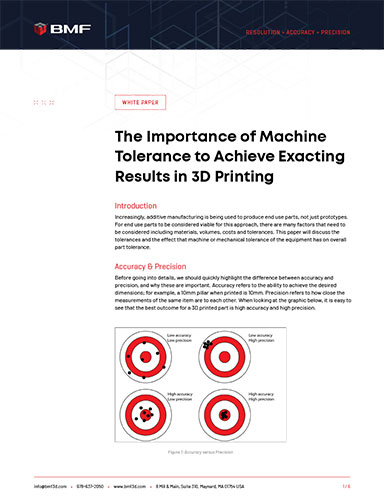
Before going into details, we should quickly highlight the difference between accuracy and precision, and why these are important. Accuracy refers to the ability to achieve the desired dimensions; for example, a 10mm pillar when printed is 10mm. Precision refers to how close the measurements of the same item are to each other. When looking at the graphic below, it is easy to see that the best outcome for a 3D printed part is high accuracy and high precision.
The ability to hold high accuracy and precision in additive manufacturing depends on multiple factors. Resolution of the data coming from the software plays a part. Behavior of materials (shrinkage or expansion) plays a part. Choreography of slicing and layer thickness plays a part.
In the end, all these factors are limited by the machine tolerance of the actual device being used. If machine tolerances are “loose”, the ability to hit tight dimensions is limited. If machine tolerances are “tight”, there is a greater ability to meet high accuracy and precision.

Boston Micro Fabrication is the world leader in micro-precision 3D printers utilizing Projection Micro Stereolithography (PµSL) technology. Many leading companies worldwide are adopting PµSL to 3D print true microstructures with ultra-high…

Ultra-high Accuracy, Precision, and Resolution Micro 3D Printed Medical Device Manufacturing
Discover how the use of micro-precision 3D printing is aiding medical device producers to tackle two common issues through this white paper.




About Us · Contact Us · Editorial Team · Advertising · Privacy Policy · Subscriber Services · © 2026 Digital Engineering 24/7 · Peerless Media