Helping design and engineering professionals discover, evaluate and specify technologies and processes that shorten the design cycle and enable success.



Digital Engineering April 2026
In the latest issue of Digital Engineering, we take a look at the latest innovations in design for additive manufacturing, including the use of natural language inputs, social media cosplayers, and AI integration. The issue also includes a feature…

January Special Focus Issue: Design for Additive
In this Special Focus Issue of Digital Engineering, learn about the latest advancements in design for additive manufacturing, including new software tools, additive in automotive, custom medical devices, and more.
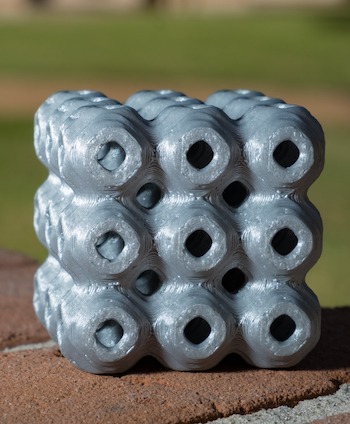
Printed as polymer models, the schwarzites could potentially be used to create batteries, nanoscale electronics, molecular sieves, and even large items like buildings and airplanes. They are porous and use little material, but are still extremely strong.
"The geometries of these are really complex,” said Rice postdoctoral researcher Chandra Sekhar Tiwary. “Everything is curved, the internal surfaces have negative curvature, and the morphologies are very interesting. Schwarzite structures are very much the same. The theory shows that at the atomic scale, these materials can be very strong. It turns out that making the geometry bigger with polymer gives us a material with a high load-bearing capacity.”
The schwarzites are strong but also compressable. Any load applied is transferred across the entire structure, regardless of the direction of the force. The researchers tested primitive and gyroid structures.
"It is a little surprising that some atomic-scale features are preserved in the printed structures," said Douglas Galvão, a professor at the University of Campinas. “We discussed that it would be nice if we could translate schwarzite atomic models into 3D printed structures. After some tentatives, it worked quite well.”
According to the researchers, a building made of the material would collapse very slowly if it underwent some sort of catastrophic impact.
“The way a material breaks is important,” Tiwary said. “You don’t want things to break catastrophically; you want them to break slowly. These structures are beautiful because if you apply force to one side, they deform slowly, layer by layer.
The team next wants to refine the objects using higher resolution printers, which could make the blocks lighter. They also think they could print ceramic and metallic schwarzites on a larger scale in the future.
You can read about their work in Advanced Materials.
Source: Rice University


Brian Albright is the editorial director of Digital Engineering.
Contact him at [email protected].

Join over 90,000 engineering professionals who get fresh engineering news as soon as it is published.






About Us · Contact Us · Editorial Team · Advertising · Privacy Policy · Subscriber Services · © 2026 Digital Engineering 24/7 · Peerless Media