Helping design and engineering professionals discover, evaluate and specify technologies and processes that shorten the design cycle and enable success.


Alert!
Digital Engineering ceased publication on July 1, 2026. This website remains available as an archive of engineering content.
For inquiries or information, please email [email protected].

Digital Engineering April 2026
In the latest issue of Digital Engineering, we take a look at the latest innovations in design for additive manufacturing, including the use of natural language inputs, social media cosplayers, and AI integration. The issue also includes a feature…

January Special Focus Issue: Design for Additive
In this Special Focus Issue of Digital Engineering, learn about the latest advancements in design for additive manufacturing, including new software tools, additive in automotive, custom medical devices, and more.
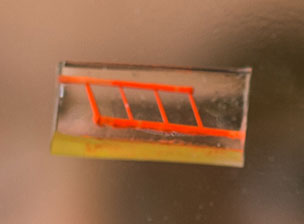
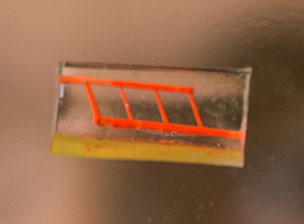 Red dye shows the tiny vessels in the silicone construct printed at Rice University. Image Courtesy Jeff Fitlow/Rice University.
Researchers at Rice University and the University of Pennsylvania may have come up with a solution — an implant that includes a network of blood vessels, created using a 3D printer.
The research was published in Tissue Engineering Part C: Methods earlier this year.
Using a technique inspired by the sugar glass cages pastry chefs use to decorate cakes, the team crafted a lattice of potential blood vessels with filaments of sugar glass and an open-source 3D printer. The hardened sugar is placed in a mold and covered with silicone gel. The sugar is then dissolved, creating tiny channels in the silicone.
“They don’t yet look like the blood vessels found in organs, but they have some of the key features relevant for a transplant surgeon,” said Jordan Miller, assistant professor of bioengineering at Rice, and leader of the research team. “We created a construct that has one inlet and one outlet, which are about 1 millimeter in diameter, and these main vessels branch into multiple smaller vessels, which are about 600 to 800 microns.”
Surgeons at the University of Pennsylvania connected the inlet and outlet in the structure to an artery in a small animal model. It remained open for blood flow for up to three hours.
“This study provides a first step toward developing a transplant model for tissue engineering where the surgeon can directly connect arteries to an engineered tissue,” Miller said. “In the future we aim to utilize a biodegradable material that also contains live cells next to these perfusable vessels for direct transplantation and monitoring long term.”
Source: Futurity


Brian Albright is the editorial director of Digital Engineering.
Contact him at [email protected].






About Us · Contact Us · Editorial Team · Advertising · Privacy Policy · Subscriber Services · © 2026 Digital Engineering 24/7 · Peerless Media