Helping design and engineering professionals discover, evaluate and specify technologies and processes that shorten the design cycle and enable success.




May 2026 Special Focus: Artificial Intelligence in Design and Simulation
In this Special Focus Issue, learn about the latest developments in the integration of artificial intelligence into engineering workflows.

April 2026 Special Focus Issue: Generative Design
In this Special Focus Issue, Digital Engineering takes a look at how generative design solutions can be used across different types of design problems and with a variety of manufacturing approaches to accelerate design space exploration, and…
Solutions to these sorts of problems rarely appear all at once. Rather, it takes the collective creativity of the technical research field to build a solution in a series of steps, each breakthrough building on the last. In the case of simpler 3D modeling, the next step might be the result of research by Ariel Shamir, from the Interdisciplinary Center at Herzliya, and Daniel Cohen-Or and Tao Chen from Tel Aviv University.
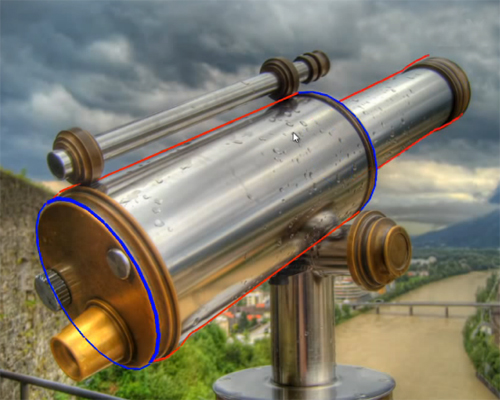
The cooperative research has developed a method of pulling 3D designs from 2D images that has potential for improving both current and future 3D design. Dubbed 3-Sweep by the research team, the system uses both computer and user generated data to build 3D objects. As anyone who has ever used Photoshop could testify, computers aren’t great at grabbing the proper information from pictures without help. Ariel Shamir explains how humans can help the machines:
Our technique provides the user the means to quickly create editable 3D parts— human assistance implicitly segments a complex object into its components, and positions them in space. In our interface, three strokes are used to generate a 3D component that snaps to the shape’s outline in the photograph, where each stroke defines one dimension of the component. The computer reshapes the component to fit the image of the object in the photograph as well as to satisfy various inferred geometric constraints imposed by its global 3D structure.
Like any newly developed program, the process isn’t perfect. Objects that aren’t completely visible can’t be modeled, and objects that suddenly change the type of shape involved (such as a toothpaste container) don’t build proper 3D models. The program also has difficulty picking out edges of fuzzy materials, or objects with a lot of shadows or a soft background, as is the case with the aforementioned Photoshop reference.
So how does this program help 3D design? Every part is made up of basic shapes. Even lacking a picture of an object, a program that quickly builds 3D data from a library of potential shapes would speed up the 3D design process, particularly for people without years of training and practice with CAD programs. As I said earlier, 3-Sweep looks to me like the next step in simplifying 3D design, and one could easily imagine future programs building upon it.
Below you’ll find a video about 3-Sweep.
Sources: Singularity Hub, Ariel Shamir


John Newman is a Digital Engineering contributor who focuses on 3D printing. Contact him via [email protected] and read his posts on Rapid Ready Technology.
Follow DE
Join over 90,000 engineering professionals who get fresh engineering news as soon as it is published.






About Us · Contact Us · Editorial Team · Advertising · Privacy Policy · Subscriber Services · © 2026 Digital Engineering 24/7 · Peerless Media