Helping design and engineering professionals discover, evaluate and specify technologies and processes that shorten the design cycle and enable success.


Alert!
Digital Engineering ceased publication on July 1, 2026. This website remains available as an archive of engineering content.
For inquiries or information, please email [email protected].

Digital Engineering April 2026
In the latest issue of Digital Engineering, we take a look at the latest innovations in design for additive manufacturing, including the use of natural language inputs, social media cosplayers, and AI integration. The issue also includes a feature…

January Special Focus Issue: Design for Additive
In this Special Focus Issue of Digital Engineering, learn about the latest advancements in design for additive manufacturing, including new software tools, additive in automotive, custom medical devices, and more.
Australian company SPEE3D has developed and tested a fast and affordable way to 3D print anti-microbial copper onto metal surfaces. Laboratory tests have shown that touch surfaces modified by this process "contact kills" 96% of SARS-CoV-2, the virus that causes COVID-19, in just 2 hours.
The process, known as ACTIVAT3D copper, has been developed by modifying SPEE3D’s 3D printing technology, using new algorithms for controlling their metal printers to allow existing metal parts to be coated with copper. Copper parts are difficult to produce using traditional methods and thus 3D printing may help rapidly deploy copper.
Australian NATA accredited clinical trial specialty laboratory, 360Biolabs, tested the effect of ACTIVAT3D copper on live SARS-CoV-2 in their Physical Containment 3 (PC3) laboratory. The results showed that 96% of the virus is killed in two hours and 99.2% of the virus killed in 5 hours, while stainless steel showed no reduction in the same time frame. Stainless steel is currently the material typically used in hygiene environments.
With laboratory testing complete, it is hoped the Australian-developed breakthrough can be applied to common touch items like door handles, rails and touch plates in hospitals, schools and other public places.
“The lab results show ACTIVAT3D copper surfaces behave much better than traditional stainless, which may offer a promising solution to a global problem," SPEE3D CEO, Byron Kennedy says. "The technology can be used globally addressing local requirements, be they in hospitals, schools, on ships or shopping centers.”
SPEE3D developed the technique to harness copper’s proven abilities to eradicate bacteria, yeasts and viruses rapidly on contact by breaking down the cell wall and destroying the genome. This is compared to traditional surfaces like stainless steel and plastic, with recent studies showing that SARS-CoV-2 can survive on these materials for up to 3 days.
Stainless steel and plastic surfaces can be disinfected; however, the problem with these surfaces is that, even with rigorous protocols, it is impossible to clean them constantly, according to SPEE3D. When surfaces become contaminated between cleans, touching them may contribute to superspreading events. Touching contaminated objects, known as fomite transmission, was suspected during the 2003 SARS-CoV-1 epidemic and analysis of a nosocomial SARS57 CoV-1 superspreading event concluded that touching contaminated objects (fomites) played a significant role.
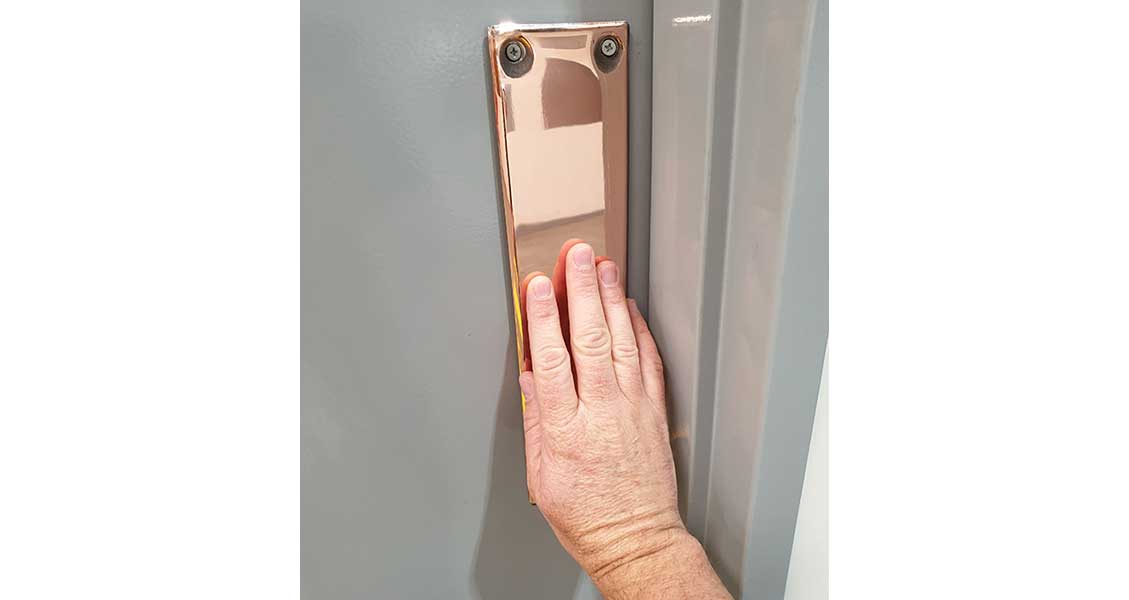
To validate its abilities to combat COVID-19, copper samples printed by SPEE3D have been lab-tested and shown to kill SARS-CoV-2. The SPEE3D team developed a process to coat a stainless-steel door touch plate and other handles in just 5 minutes. The digital print files were then sent to participating partners around the globe, allowing the simultaneous installation of newly-coated parts in buildings in the USA, Asia and Australia. In a matter of days, copper fixtures were installed in buildings at Charles Darwin University (CDU) in Darwin, Swinburne University in Melbourne, the University of Delaware in the USA and in Japan.
SPEE3D has worked in close collaboration with the Advanced Manufacturing Alliance (AMA) at Charles Darwin University. The initial testing of ACTIVAT3D copper and future studies have been funded and supported by the National Energy Resources Australia (NERA).
Sources: Press materials received from the company and additional information gleaned from the company’s website.


DE's editors contribute news and new product announcements to Digital Engineering. Press releases may be sent to them via [email protected].
Follow DE






About Us · Contact Us · Editorial Team · Advertising · Privacy Policy · Subscriber Services · © 2026 Digital Engineering 24/7 · Peerless Media