Helping design and engineering professionals discover, evaluate and specify technologies and processes that shorten the design cycle and enable success.



Digital Engineering April 2026
In the latest issue of Digital Engineering, we take a look at the latest innovations in design for additive manufacturing, including the use of natural language inputs, social media cosplayers, and AI integration. The issue also includes a feature…

January Special Focus Issue: Design for Additive
In this Special Focus Issue of Digital Engineering, learn about the latest advancements in design for additive manufacturing, including new software tools, additive in automotive, custom medical devices, and more.
The extent of use of additive manufacturing in the automotive industry really comes down to confidence in its capacity as a tool for production and, what may be most significant—cost, which still largely influences whether companies pursue high-volume production.
For instance, because performance vehicles cost big money to produce, such manufacturers usually have change to spare when manufacturing specialized parts and components, making AM a cost-effective fit.
But what about the rest of the automotive industry—does AM really make economic sense? Can it support large-scale production of parts? How exactly is its use being adopted across the sector? Digital Engineering reached out to several companies in AM who addressed their successes and limitations in using AM as a tool to impact automotive parts production and more.
Conflux Technology, an Australian advanced manufacturing company, designs and produces metal additive manufactured heat exchangers for use in production vehicles, motorsport, aerospace, and defense applications.
“From where we sit, the headline trend in automotive AM is straightforward: 3D printing has moved from ‘prototyping and curiosity’ to a legitimate tool in the production toolkit—and adoption is accelerating,” says Daniel Woodford, CEO, Conflux Technology. “Two forces are driving this.
The No. 1 driving force for the 3D printing shift from prototyping to a tool for production, according to Woodford, is confidence. “There is now a growing body of certification evidence and experience that AM delivers—production parts, race-proven components, multi-year OEM contracts. That self-reinforcing knowledge base is lowering the barrier for procurement and engineering teams to specify AM parts.”
The other force, which may be obvious, is cost. “The economics are improving materially, driven by higher productivity, lower cost AM platforms (particularly in metal) and companies like Conflux investing deliberately in cost-down manufacturing strategies,” Woodford suggests.
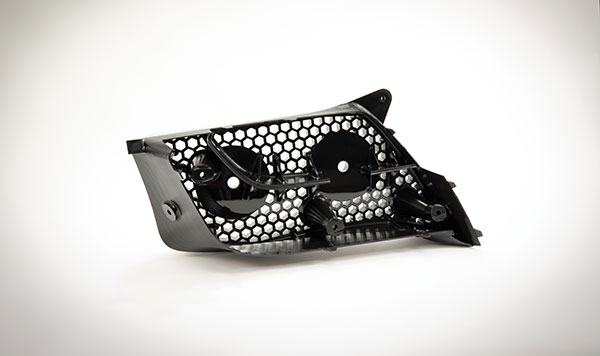
Automotive grill prototype created using 3D Systems SLA 3D printing and Accura AMX Rigid Black material. Image courtesy: 3D Systems
Although Conflux sees economic bright spots, Eric Utley of Protolabs says it’s still critical to understand the financial piece with automotive: “It’s an industry laser-focused on cost per part. That’s always been one of the main reasons 3D printing hasn’t moved more broadly into high-volume production. The technology is really good at making complex parts with high-performance features like lightweighting, but automotive companies are constantly trying to drive costs down to the absolute minimum.”
Joe Dopkowski, business development manager, 3D Systems, says the cost factor is related to volumes. According to Dopkowski, volume is “always at the leading edge of cost-driven solutions. When you’re manufacturing millions and millions of components a year, tenths of a penny start to add up quickly. The end customer for volume automotive is also very price sensitive. The main hurdle [for AM] to be used at a greater scale is cost.”
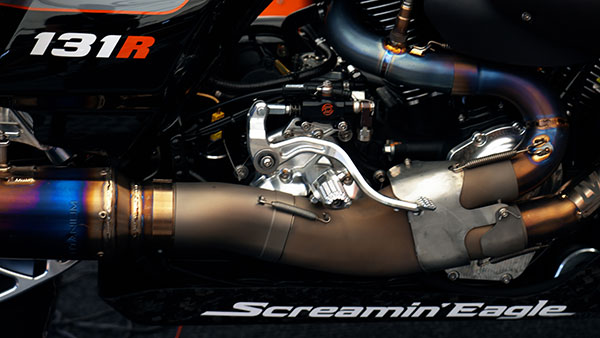
A view of the side of a Harley-Davidson racing motorcycle engine and 3D-printed exhaust system designed to get closer to the ground on turns, according to Eric Utley of Protolabs. Image courtesy: Protolabs
That said, what may influence increased adoption of AM in automotive is supply chain pressure, according to Bruno Romero, HP Additive Manufacturing EMEA applications engineer manager. “As companies look to reduce inventory and produce parts closer to where they are needed, on-demand, localized production is making additive manufacturing a more practical solution.”
Romero continues, “Historically, cost per part and throughput limited its use beyond prototyping. That is now changing as systems become more productive and materials more efficient.”
Cost aside, innovations and developments in AM also increase its attractiveness to the automotive sector.
“…advances in automation, software, and workflow integration are making it easier to move from design to production using the same processes and materials. This allows engineering teams to produce functional parts in-house and reduces the gap between design, validation, and manufacturing,” HP’s Romero adds.
Protolabs’ Utley notes more developments tipping the scales in favor of AM.
“For high-performance vehicles, 3D-printed parts that are complex or require lightweighting are still a strong application for 3D printing,” Utley says, as is mass customization. “More OEMs are offering customization features that fit nicely with low-volume manufacturing methods like additive.” Another growing opportunity involves replacement parts, especially for older vehicles, or components that aren’t easy to source.
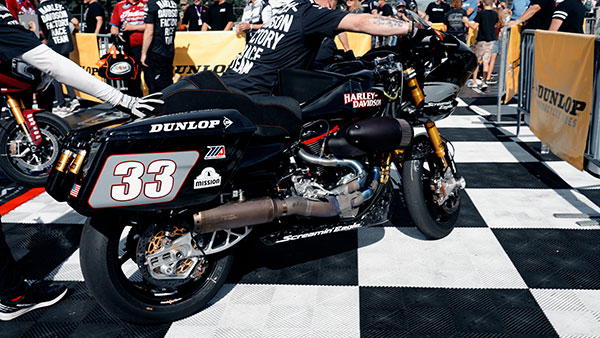
Pictured here is the right side of a Harley-Davidson racing bike, which features a 3D printed exhaust system, a collaborative effort involving Protolabs. Image courtesy: Protolabs.
Collaboration helps fuel the integration of AM in automotive especially in the performance vehicle segment. “Conflux’s automotive engagement runs across the high-performance spectrum—from motorsport at the sharp end through to low-volume hypercar and supercar OEM production,” shares Woodford. The company’s longest automotive relationships are in motorsport, including Formula One, where performance expectations and tolerance for AM technology have been high.
On the OEM side, Woodford spoke of two specific programs that Conflux has worked on all the way to production.
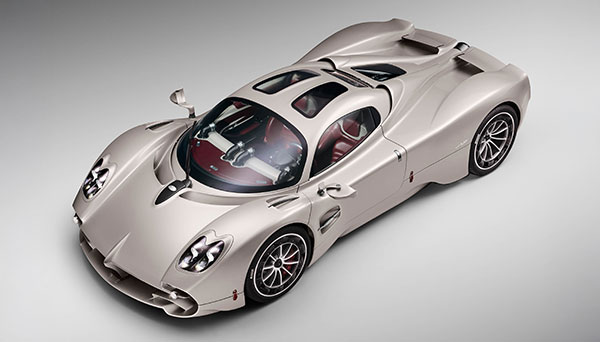
Pagani Utopia — Conflux developed a bespoke transmission oil cooler for the Pagani Utopia hypercar. The Utopia’s V12-powered drivetrain demanded “exceptional” thermal management of its transmission oil circuit, particularly under track conditions. Conflux delivered a 30% increase in heat rejection compared to the previous solution, Woodford notes.
Donkervoort P24 RS — Donkervoort selected Conflux’s barrel water charge air coolers for their upcoming P24 RS supercar — a 600 hp, twin-turbo V6 in a 780 kg car. The P24 RS will carry two Conflux WCACs, utilizing cylindrical designs placed directly between the turbochargers and throttle bodies. Each unit features tailored fin geometry, density, and size.
“These are production programs, not prototypes—and they reflect what we believe is a broader shift in how performance vehicle manufacturers are approaching thermal management,” Woodford says.
Smaller parts can present a strong case for 3D printing, according to Utley. “3D printing tends to make the most sense when the part is relatively small, fairly detailed, needed in lower volumes, or likely to be redesigned a few times. That’s where we’re seeing the most traction. It’s less about trying to compete with traditional manufacturing on huge production runs and more about helping customers move faster, iterate faster and solve problems that conventional processes don’t handle as well.”
Again, though, the size of the component being produced can limit AM’s use, notes Dopkowski. “Large components are likely to still be made with traditional methods that can support the large component size. Metal structural components, turbochargers, engine internals, interior panels, gaskets and electronics enclosures, even the molds used to manufacture tires, can and are being made additively,” he shares.
Yet AM is in play for a broader range of automotive components today. “Additive has really worked its way, in some way/shape or form, into virtually all components—whether it is the end-use part itself, prototyping of that component or fixturing to assemble the final components,” Dopkowski adds.
For performance vehicles, use cases for AM can include “everything from quick iteration wind tunnel testing to lightweight structural components for reducing unsprung mass and everything in between,” says 3D Systems’ Dopkowski. “Performance vehicles are very purpose-focused (performance) and less price sensitive as long as the tool applied (additive) provides the solution that is being looked for.”
At Protolabs, Utley breaks down use cases by category:
Prototyping: A large amount of work here centers on interior components, housings, headlights, taillights, and development parts, Utley notes.
Low-volume production: Such as for EV startups and specialty vehicles
Aftermarket and replacement parts: ”In situations where parts are out of market, 3D printing can be a very practical way to make replacement plastic components like housings, covers, and more,” Utley says.
Sensor-related parts: Including LIDAR and other autonomous or advanced driver-assistance components. “Those parts are often small, detailed, and subject to rapid design updates, which plays to the strengths of additive.”
Racing and performance applications: “Customers are often willing to pay more if it means getting a lighter or better-performing part,” Utley says.
One use case example that Protolabs’ Utley shared by name is Harley-Davidson, whose factory racing team has teamed up with Protolabs on a racing bike. “For example, we recently printed a new exhaust system for their racing bike that allows the bike to get closer to the ground on turns without scraping the exhaust. Design freedom and lightweight titanium achievable through additive manufacturing make a ton of sense for this application,” Utley shares.
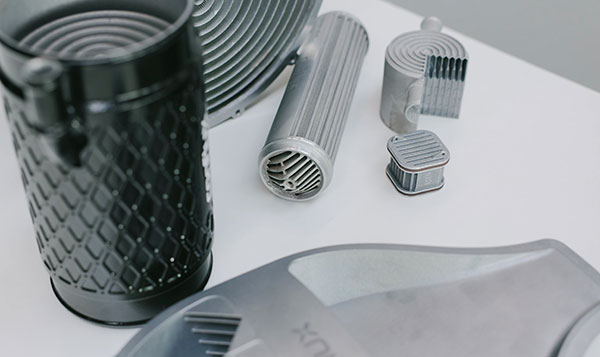
At Conflux Technology, thermal management is the primary category for AM use. “Our focus is squarely on production thermal management components—high-performing, reliable heat exchangers that go into vehicles,” says Woodford.
The specific use cases the company is addressing include:
• Water charge air coolers / intercoolers—cooling charged air between the turbocharger and the engine.
• Oil coolers—transmission, gearbox, and powertrain oil cooling for motorsport and road-going applications.
• Bespoke / extreme packaging applications—for customers with specific geometric constraints, aesthetic requirements, or integration challenges, the company develops purpose-designed AM heat exchangers.
For its metal heat exchangers, Conflux turns to AM platforms such as the EOS M290 and M300 laser powder bed fusion (LPBF) systems.
At HP, Romero adds serial production to the mix: “The goal is to enable serial production parts where there’s the highest value. In the case of serial production, cases such as the recent launch of Renault E5 demonstrate there is a market for car personalization where the buyer can purchase accessories, which are additively manufactured, from Renault’s website. Other OEMs such as Alpine A110 R or GM Tahoe saw the potential for manufacturing visible components.”
In another example, Romero shares how Blazin Rodz, a California-based maker of custom cars, has integrated “more than 75 Multi Jet Fusion–printed parts into a fully functional vehicle, showcasing how additive enables faster, more flexible and highly personalized production.”
The trajectory is clear: AM will occupy an increasingly significant role in automotive production, not just prototyping, according to Woodford. “The cost curve is moving in the right direction, the engineering community’s confidence in AM is growing, and the performance advantages—particularly for thermal management—are well established.
“I expect to see the production volume threshold at which AM is cost-competitive continue to shift upward, opening new application areas beyond the current high-performance / low-volume sweet spot,” Woodford adds.
Utley of Protolabs has a more tempered view, because of the cost pressure, “so I don’t think additive suddenly replaces traditional manufacturing for mainstream high-volume parts. But I do think it continues to grow in the areas where it brings clear value. That includes premium vehicles, racing, low-volume programs, aftermarket parts, and the rapidly evolving technologies like sensors and electrification components.”
Utley also likes the growth potential of AM in mass customization. ”Additive is naturally a good fit for custom accessories, trim pieces, and personalized components because you don’t need tooling and you can make low volumes economically. There’s also probably an AI angle to that over time. As design tools get better, it may become much easier to create customized parts or accessories and then manufacture them through additive. At the high end, you’ll also keep seeing additive paired with advanced design tools for lightweight, performance-driven parts.”
Romero at HP suggests that automotive production “is shifting toward lower volumes, greater variation, and shorter development cycles,” which will amplify the demand for flexible manufacturing methods. Over time, additive manufacturing will become a more established part of the production mix, used to enable more responsive and adaptable production models, particularly in areas where speed and complexity are critical,” Romero concludes.
Dopkowski of 3D Systems sees the future of AM in automotive through the lens of the EV: “…there are still advantages to be gained from weight reduction in terms of efficiency. Lighter vehicles are more efficient, have less impact on the roads and are more fun to drive!”


Stephanie is the Associate Editor of Digital Engineering.
Follow DE
Join over 90,000 engineering professionals who get fresh engineering news as soon as it is published.






About Us · Contact Us · Editorial Team · Advertising · Privacy Policy · Subscriber Services · © 2026 Digital Engineering 24/7 · Peerless Media