Helping design and engineering professionals discover, evaluate and specify technologies and processes that shorten the design cycle and enable success.



May 2026 Special Focus: Artificial Intelligence in Design and Simulation
In this Special Focus Issue, learn about the latest developments in the integration of artificial intelligence into engineering workflows.

April 2026 Special Focus Issue: Generative Design
In this Special Focus Issue, Digital Engineering takes a look at how generative design solutions can be used across different types of design problems and with a variety of manufacturing approaches to accelerate design space exploration, and…
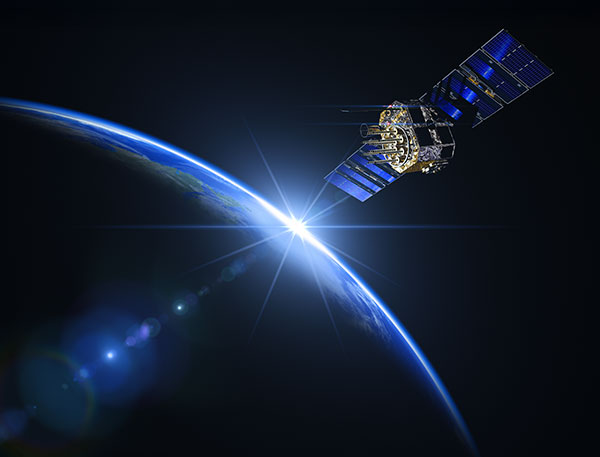
Earlier this year, Elon Musk announced that his SpaceX company would put data centers into Earth’s orbit to help meet the enormous need for compute power generated by artificial intelligence (SpaceX has merged with Musk’s xAI project) while reducing the need for power.
“You’re power constrained on Earth,” he said. “Space has the advantage that it’s always sunny.”
What Musk has described is a constellation of satellites acting as compute nodes for this orbital data center; he has further predicted that the cost of such a project would soon fall below the cost of building and powering a terrestrial data center.
But will it? Can this actually work?
The short answer is: probably not, at least not under current conditions; but maybe, for more limited types of applications.
Before we get into why there are going to be constraints on putting AI data centers in space, it’s important to note that this is a proposed solution to a very real problem. AI data center power consumption is expected to double to nearly 1,000 terawatt-hours in a few years. Data centers are having a real effect on energy prices in the communities where they are being built, and that has led to pushback from local residents and environmental groups, and in some cases has shut down or delayed new data center projects.
Some companies are building dedicated power infrastructure for data centers or proposing small-scale nuclear reactors to power them. But Musk isn’t the only one with his head in the stars. The start-up Starcloud put an NVIDIA H100 chip on one of its craft last year, the first step in what it, too, hopes will be an orbital data center project. Google’s project Suncatcher is also in the works, and would be an 81-satellite cluster built with the satellite-imagery company Planet.
Another company, Aethero, is designing a distributed, edge computing concept for space applications, leveraging Ansys simulation solutions from Synopsys to analyze its satellites.
There are smaller scale applications where having compute resources in space has a real value. For example, having extraterrestrial data centers analyze Earth observation data (like weather patterns, for example) could benefit from having compute and data collection co-located on a satellite.
“These satellites are looking at what’s happening on the surface of the earth,” says Walter Frei, principal applications engineer at COMSOL. “We want that information as soon as possible, but collecting it from orbit can be challenging. You want to preprocess that data as much as possible and send it down to the end user. That’s reasonable.”
This type of data center application would require a larger version of existing satellites with more communication bandwidth. What Musk is proposing is much more elaborate.
But to operate a data center, whether in space or in New Jersey, there are two significant constraints—power and heat transfer. Theoretically, putting a data center in space solves both because there is infinite solar energy available, and space is very cold. It’s not that simple, however, and building a functional data center array in space creates as many problems as it solves.
In a recent webinar titled “Orbital Data Centers: Can Bitcoin Be Mined in Space?”, Maya HTT examined the simulation and design challenges of creating space-based compute nodes for a cryptocurrency application. Bitcoin mining on Earth consumes a lot of expensive electricity and generates significant heat (requiring thermal management); profitability of these operations is highly dependent on the cost of electricity.
In this particular example, modeled using Siemens Simcenter tools, the presenters noted that there were significant tradeoffs when it came to powering such a system. “You would need to rely entirely on solar power, and that sounds amazing because solar is free,” said Jean-Francoise Labrecque-Piedboeuf, product line manager for space at Maya HTT. “We do have more solar energy in space than on Earth, but it’s not straightforward because you need more panels and cells, which are not that efficient.” In the Maya HTT model, it simply was not cost-efficient to push this type of work into orbit.
While there is no sunset in space, an orbiting satellite is still not always in direct sunlight. The solar panels would need to be periodically repositioned to capture the sun’s rays, requiring some motors and controls, and all of that adds cost and weight. In addition, the size of solar panels would need to be enormous. The International Space Station has panels nearly half the size of a football field that generate roughly 100 kilowatts of power. Scaling that up into megawatts would require exponentially larger panels that would constantly be exposed to collisions with space debris.
“Elon Musk is talking about terawatt-scale data centers in space,” says Sherman Ikemoto, group director at Cadence Design Systems. “Doing some quick calculations, the size of the solar panels that would be required would cover half the United States.”
The solar panels would also need to move to maintain constant power. “There are orbits available that are always exposed to the sun, independent of the spin of the Earth,” says Ikemoto. “But in order to maximize exposure, as the satellite is orbiting you still need some way of reorienting the solar panels.”
“You will get an order of magnitude more energy out of solar in space, but only if the panel is pointing at the sun the entire time,” Frei says. “You’d also need a really big solar panel—tens of meters in size, and it would need to be reoriented constantly. It would need to be larger than the International Space Station, and include thrusters and hardware to move it. How do you get it up there, and what happens if anything hits it?”
While space is very cold, the heat generated by the computers on these orbiting satellites still has to be transferred away from the components. On Earth, air gives us free convection that helps move this heat. Data centers increasingly rely on liquid cooling systems to efficiently remove heat.
“People talk about cooling space is so easy and so free because space is cold, but actually it’s not that simple,” Frei says. Because space is a vacuum, you can’t use air or water to carry heat away. The heat has to radiate away from the hardware. The Stefan-Boltzmann law requires more than 1,000 square meters of radiator surface for the thermal output of a single megawatt of computing power (this can vary based on operating temperature). The satellite would also be absorbing solar energy, further increasing the thermal management challenge. New passive thermal controls under development would help, but this is still a significant engineering challenge.
“The major difference in space is the mode of heat transfer has to be conduction and radiation only; there is no fluid or air flow,” Ikemoto says. “It’s cold in space, but when thinking about heat transfer it’s not as straightforward as just putting something in a freezer. You don’t want to have to conduct heat out to a radiator over a long distance, because you lose efficiency. The design challenge doesn’t go away no matter what environment you are in.”
There are other problems to solve as well. Shielding components from cosmic radiation would be complex and potentially add significant weight. Microchips aren’t static; upgrading server farms with the latest and greatest CPUs and GPUs requires physical access to the hardware; orbiting data centers could wind up being computationally obsolete in a few years.
“We don’t know how much shielding you’d need for a data center,” Frei says. “Ideally you want as little as possible, but you need to shield it from cosmic radiation. We have had solar flares that take out the electrical grid on Earth. It would be an absolutely infrastructure-ending event for a space-based data center.”
Data centers on Earth are also designed for compactness, with the chips as close together as possible to maximize communication between the components. In space, though, planar flat surfaces are optimal for heat dissipation. “You want maximum computing density in a three-dimensional sense,” says Frei. “In space, though, you want them as far apart as possible because you cannot build a better radiator than a flat, thin sheet. You can’t make things compact in space.”
“There are so many things that make this complicated,” Ikemoto says. “You can’t launch something that heavy preassembled, but if you launch it in pieces, what is the practical maximum size of the pieces, and the practical number of pieces needed to assemble in space to come up with the individual unit?”
Given costs and constraints, it might be a better use of resources to invest in creating more efficient data centers on Earth, and coming up with better ways to power and cool them.
“With the introduction of NVIDIA’s accelerated computing technology based on GPUs, we’ve gone into the need for liquid cooling almost overnight,” Ikemoto says. “Our company developed simulation capabilities to capture that so we’d be ready, but even we got caught off guard by the new practical technologies that had to be incorporated into the design to make cooling work—control systems and the impact of new cooling system components like valves and pumps that weren’t widely available. You have to capture the behavior of all of those things, and that level of acceleration was recent.”
“A gallon of water is the cheapest thing you can use as far as cooling efficiency,” says Frei. “We should be paying more attention to how these data centers use their water, but that is a problem that can be solved with a long pipe and reverse osmosis filters.”
Many companies are playing catch-up when it comes to incorporating advanced cooling technologies into their data center designs. “On top of that, there’s always been an education gap between the companies that design data center components, and the companies that take those components and assemble them on site into a data center,” Ikemoto says. “It’s two different worlds that never really communicated or interacted very much.”
Each year, new chips come out that are twice as fast as their predecessors at the same price, but because data center design is not optimized for those constantly evolving chips, operators get less and less performance out of each CPU and GPU.
“Imagine an F1 racing team, but the engine and body are designed by separate companies that don’t talk to each other,” Ikemoto says. “And without instructions to put the body and engine together and then run a race. You won’t win with that operating procedure. That’s what is happening in the data center world today.”
In response, Cadence and NVIDIA have partnered to help design new formulas for data center operation that take advantage of the new chips to reduce power consumption and improve performance. Simulation will play a key role in optimizing these new data centers.
“That way the entire system is optimized for maximum computational throughput at minimal cost and environmental impact,” Ikemoto says. “These are problems that need to be solved, and will require a new set of design and operating practices that have never been applied in a data center before.”


COMSOL is a global provider of simulation software for product design and research to technical enterprises, research labs, and universities. Its COMSOL Multiphysics® product is an integrated software environment for creating physics-based models…
Ebook download: Powering Clean Energy Solutions
In this ebook, we explore 6 cases where modeling and simulation were used to help overcome these new design challenges. Topics include water turbines, sand-based heat storage, hydrogen fuel cells, and more.

Brian Albright is the editorial director of Digital Engineering.
Contact him at [email protected].

Join over 90,000 engineering professionals who get fresh engineering news as soon as it is published.






About Us · Contact Us · Editorial Team · Advertising · Privacy Policy · Subscriber Services · © 2026 Digital Engineering 24/7 · Peerless Media