Helping design and engineering professionals discover, evaluate and specify technologies and processes that shorten the design cycle and enable success.



Digital Engineering April 2026
In the latest issue of Digital Engineering, we take a look at the latest innovations in design for additive manufacturing, including the use of natural language inputs, social media cosplayers, and AI integration. The issue also includes a feature…

January Special Focus Issue: Design for Additive
In this Special Focus Issue of Digital Engineering, learn about the latest advancements in design for additive manufacturing, including new software tools, additive in automotive, custom medical devices, and more.
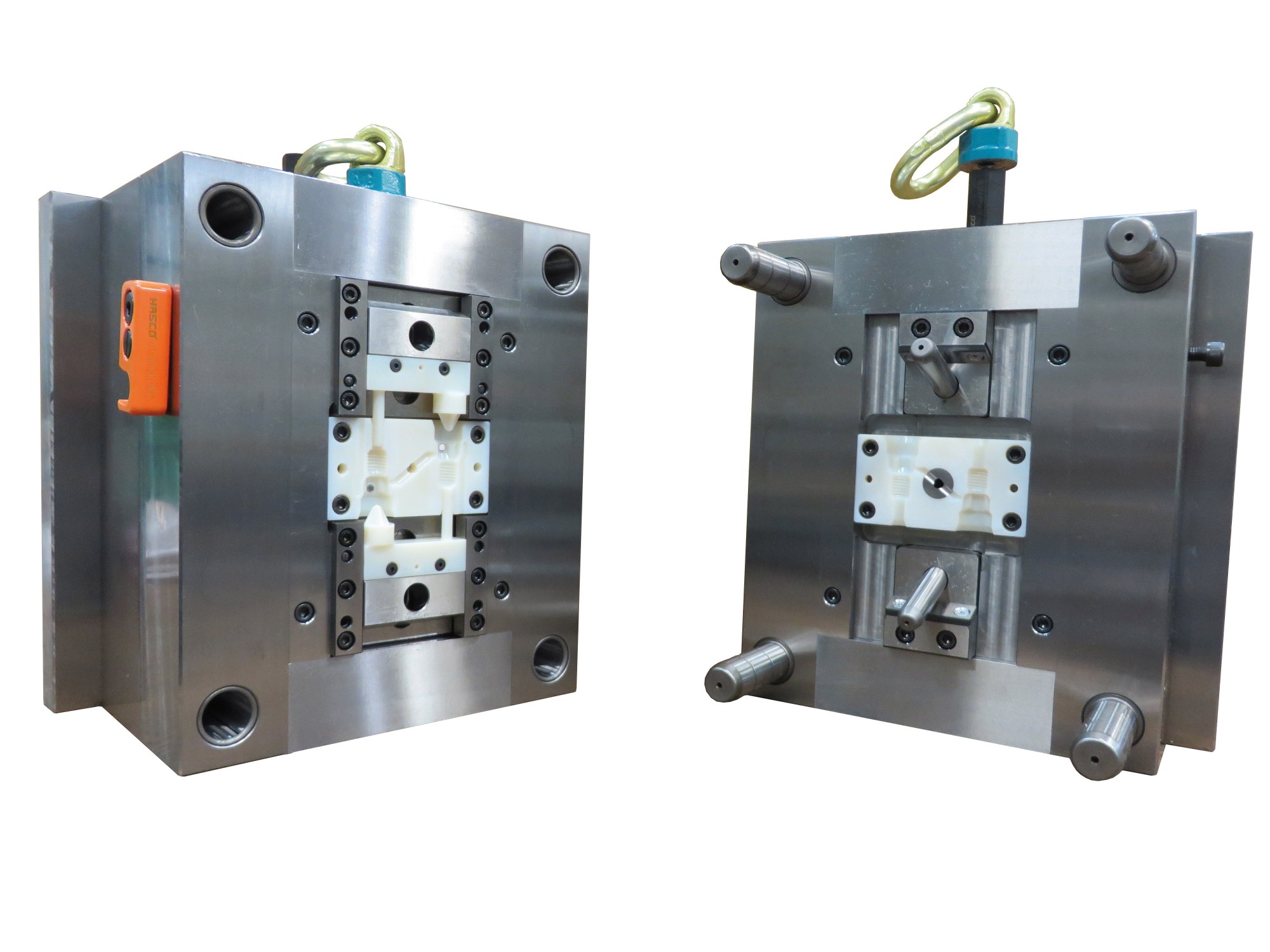
AM and traditional processes both have their pros and cons, but the two great tastes can also taste great together. HASCO, a worldwide manufacturer of molds, recently investigated the potential for mixing Stratasys’ PolyJet AM process with its mold manufacturing process.
 By combining 3D printing and injection molding, HASCO was able to produce a part impossible to build using injection molding alone. Courtesy of Stratasy.
“Through the use of tried-and-tested standardized HASCO products and Stratasys state-of-the-art 3D printing, the project has proved that it is possible to implement this innovative rapid-technology application within the injection molding process,” said Dirk Paulmann, executive VP, sales & business development at HASCO. “For the production of low-volume prototypes in the final product material, the ability to quickly change molds with a 3D printed cavity offers a rapid, low-cost alternative to conventional methods.”
HASCO felt the need for a change to standard practices when developing a new mold to produce a sealing plug for its A8001 clamping fixture. The HASCO design team found that the walls of the ABS sealing screw could not be manufactured to the required specifications by employing traditional manufacturing methods alone.
After making the decision to develop the new mold using AM, the company redesigned the mold to take advantage of the freedom of design offered by 3D printing. The test mold was completed in a single work day.
“The speed of the process was incredible,” said Paulmann. “Using our Objet500 Connex 3D Production System, we produced the parts of the cavity that shape the polymer – such as the inserts and slides – in just six hours compared to the 24 hours it previously took. We then worked with prototyping specialists Canto Ing. GmbH, Lüdenscheid to finish the 3D printed inserts and test the sample mold. We were delighted with the result, the first sealing screws were produced ready for mounting on our clamping unit in a record time of only four days.”
Below you’ll find a video about combining AM and injection molding.
Source: Stratasys


John Newman is a Digital Engineering contributor who focuses on 3D printing. Contact him via [email protected] and read his posts on Rapid Ready Technology.
Follow DE
Join over 90,000 engineering professionals who get fresh engineering news as soon as it is published.






About Us · Contact Us · Editorial Team · Advertising · Privacy Policy · Subscriber Services · © 2026 Digital Engineering 24/7 · Peerless Media