Helping design and engineering professionals discover, evaluate and specify technologies and processes that shorten the design cycle and enable success.



Digital Engineering April 2026
In the latest issue of Digital Engineering, we take a look at the latest innovations in design for additive manufacturing, including the use of natural language inputs, social media cosplayers, and AI integration. The issue also includes a feature…

January Special Focus Issue: Design for Additive
In this Special Focus Issue of Digital Engineering, learn about the latest advancements in design for additive manufacturing, including new software tools, additive in automotive, custom medical devices, and more.
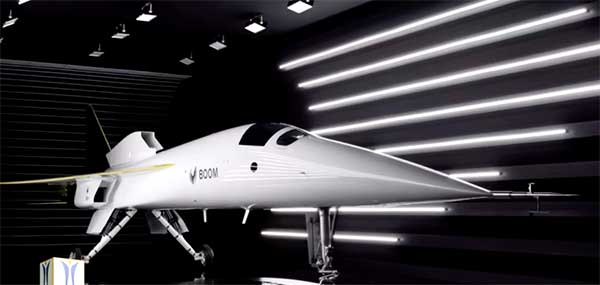
As part of Boom Supersonic’s flight plan for a return to supersonic air travel, it took a turn towards metal 3D printing as part of a parts consolidation strategy and to output some of the XB-1 aircraft’s most complex component designs.
Taking the lead from other aircraft manufacturers already equipping key aircraft with 3D printed components, Boom Supersonic decided to explore how metal AM technology from VELO3D could deliver greater design flexibility, particularly around parts consolidation. A parts consolidation strategy would be essential for streamlining production and to improve safety and efficiency, officials said.
Instead of welding or bolting together multiple parts or using carbon-fiber tools, the company’s parts consolidation approach leaned heavily on a design-for-AM strategy aimed at reducing weight by eliminating unnecessary joints and interfaces between components. “The goal of part consolidation is the elimination of parts through amalgamation,” explains Gene Miller, application engineer at VELO3D. “In utilizing additive manufacturing, several parts can often be manufactured as one without the need for fastening material (flanges, weld plates, nuts, and bolts, etc.). This is harmonious with lightweighting-of-design strategy because it reduces weight through the elimination of heavy fasteners and fastening material.”
Much of the AM effort centered around parts designed to channel air through structures such as complex vanes, ducts, and louvres, all of which have to withstand extremely high heating temperatures, often in excess of 500 degrees Fahrenheit. Given their geometric complexity, the parts required a surface-based design approach, starting with aerodynamic profiles whose surfaces were then trimmed, filleted, and thickened to create a solid part. “The unique types of geometries created for directing flow, with a focus on weight savings, couldn’t be done with sheet metal or casting or any other way,” Miller explains. “To reap the benefits of complex design and weight reduction together, the only option was to do it with metal AM.”
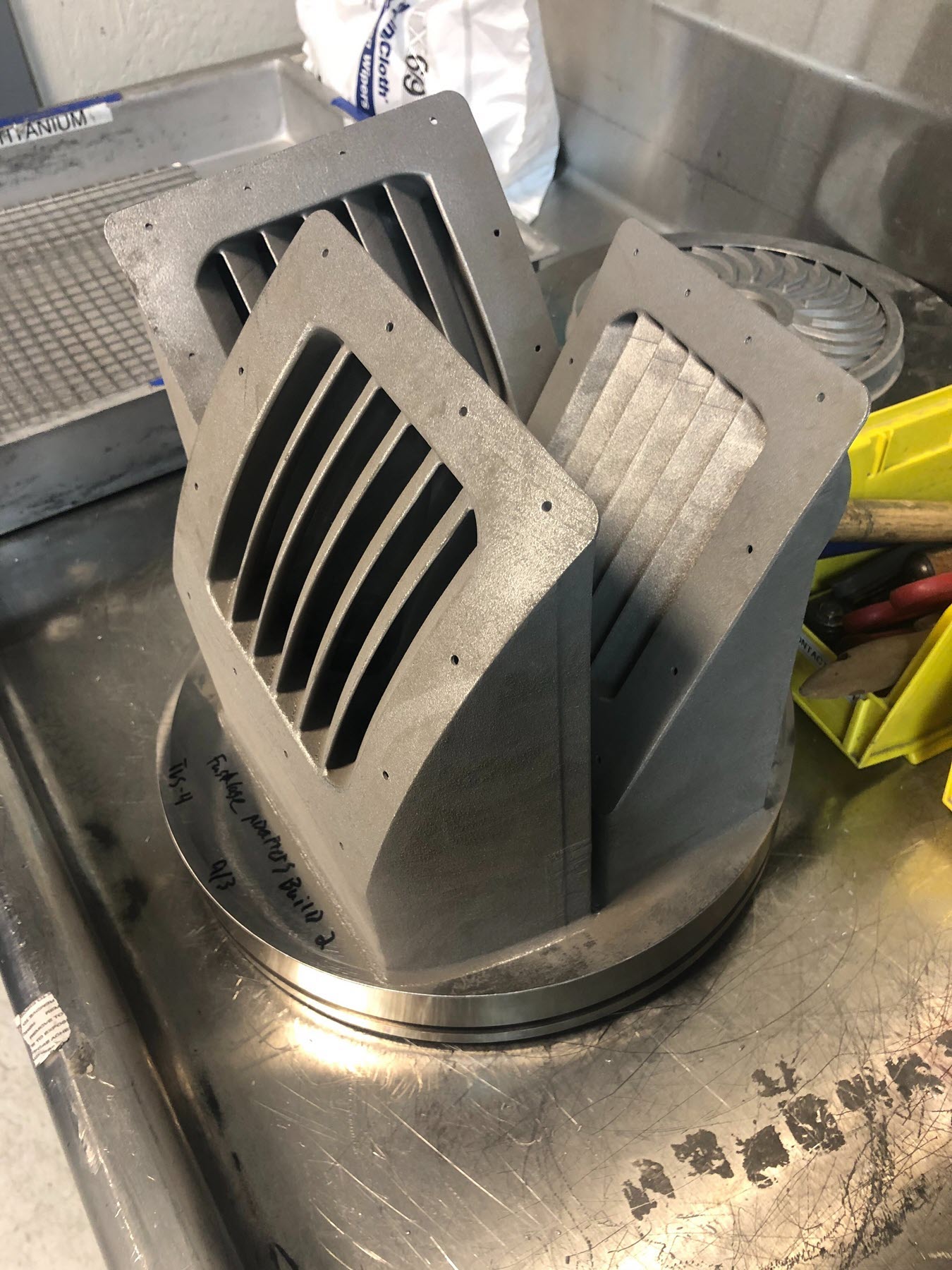
Three nestled parts on the build plate for a Variable Bleed Valve (VBV) system. Image Courtesy of VELO3D
Boom, together with its 3D printing partner Duncan Machine Products (DMP) settled on VELO3D’s Sapphire laser powder-bed fusion (LPBF) technology to produce titanium components. Among the parts designed and printed with the Sapphire technology were manifolds for the Variable Bypass Valve (VBV) system used to route air released by the engine compressor to the aircraft’s outer mold line (OML): exit louvers for the environmental control system that cools the cockpit and systems bay; louvers for directing the center inlet’s secondary bleed flow to the OML; and NACA ducts and two diverter flange parts.
The team was able to print parts directly from Boom’s CAD data, preserving the original design intent and streamlining the overall process. “Using VELO3D’s Sapphire technology, these optimized parts were manufactured according to the original design intent without the need for redesign or compromise,” Miller explains.
The choice of lightweight, heat resistant titanium did make for some challenges when it came to AM parts production. Titanium can be delicate and difficult to work with, particularly prone to cracking if it is cooled too rapidly. However, the alternative means of production—casting--would not have been able to accommodate the XB-1 thin-wall parts designs.
“To ameliorate cracking, VELO3D incorporates an in-situ stress-reduction technique that mitigates internal stresses accumulated during the printing process,” he adds. “Working through these challenges required parameter optimization, which bolstered the robustness of our stress reduction especially for thin-wall components.”
VELO3D Sapphire’s post processing functionality was also another key advantage. The system required little work to slice parts off the build plate and once they were separated, there was little in the way of post-machining work required. Support removal was also a non-issue. “You don’t have any tiny supports in small crevices or hard-to-reach places because the SupportFree technology eliminates the need for those,” Miller says.
To learn more about the effort, watch this video.


Beth Stackpole is a contributing editor to Digital Engineering. Send e-mail about this article to [email protected].
Follow DE
Join over 90,000 engineering professionals who get fresh engineering news as soon as it is published.






About Us · Contact Us · Editorial Team · Advertising · Privacy Policy · Subscriber Services · © 2026 Digital Engineering 24/7 · Peerless Media