Helping design and engineering professionals discover, evaluate and specify technologies and processes that shorten the design cycle and enable success.



Digital Engineering April 2026
In the latest issue of Digital Engineering, we take a look at the latest innovations in design for additive manufacturing, including the use of natural language inputs, social media cosplayers, and AI integration. The issue also includes a feature…

January Special Focus Issue: Design for Additive
In this Special Focus Issue of Digital Engineering, learn about the latest advancements in design for additive manufacturing, including new software tools, additive in automotive, custom medical devices, and more.
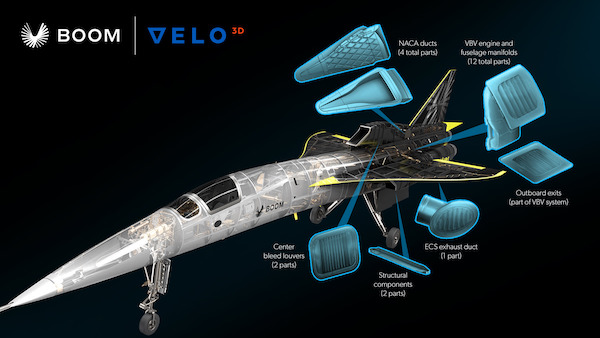
Boom Supersonic’s XB-1 aircraft includes 21 flight hardware components that were manufactured by VELO3D’s Sapphire 3D metal printer, the company announced.
“Aviation hardware is especially difficult to manufacture with 3D metal printing, due to challenging aerodynamic designs that must be balanced with superior durability and high temperature requirements,” said Benny Buller, CEO and Founder of VELO3D. “VELO3D’s technology allows the production of lightweight, complex designs for mission-critical applications in the toughest operating conditions. Our partnership with Boom is truly an advancement for the metal AM industry, and XB-1 supersonic aircraft is a game-changer for the aviation industry.”
The XB-1 supersonic jet will be used to demonstrate critical technologies for Overture, Boom’s future commercial airliner, such as advanced carbon-fiber composite construction, computer-optimized high-efficiency aerodynamics, and an efficient supersonic propulsion system.
Boom Supersonic and VELO3D announced a partnership in 2019 to manufacture flight hardware for the XB-1, and ran a series of qualification trials on VELO3D’s Sapphire system. The printed Titanium parts are used for engine hardware, the environmental control system, and structural components. Characteristics of the geometric designs include tall, thin walls with high aspect ratios, which can be difficult to manufacture using traditional processes such as welding and casting, or even many existing 3D-printing technologies.
"We strongly believe that supersonic is the future of flight and we’re appreciative of VELO3D in helping us to realize this goal with XB-1," said Mike Jagemann, head of XB-1 Production at Boom Supersonic.


DE's editors contribute news and new product announcements to Digital Engineering. Press releases may be sent to them via [email protected].
Follow DE
Join over 90,000 engineering professionals who get fresh engineering news as soon as it is published.






About Us · Contact Us · Editorial Team · Advertising · Privacy Policy · Subscriber Services · © 2026 Digital Engineering 24/7 · Peerless Media