Helping design and engineering professionals discover, evaluate and specify technologies and processes that shorten the design cycle and enable success.


Alert!
Digital Engineering ceased publication on July 1, 2026. This website remains available as an archive of engineering content.
For inquiries or information, please email [email protected].

Digital Engineering April 2026
In the latest issue of Digital Engineering, we take a look at the latest innovations in design for additive manufacturing, including the use of natural language inputs, social media cosplayers, and AI integration. The issue also includes a feature…

January Special Focus Issue: Design for Additive
In this Special Focus Issue of Digital Engineering, learn about the latest advancements in design for additive manufacturing, including new software tools, additive in automotive, custom medical devices, and more.
The technology to print a building can also be environmentally friendly, using local materials to provide shelter for homeless people around the world. What can top that? Roofing, literally. Resilient Modular Systems (RMS) is a startup that is looking to additive manufacturing (AM) to help solve roofing issues in the poorer sections of the world.
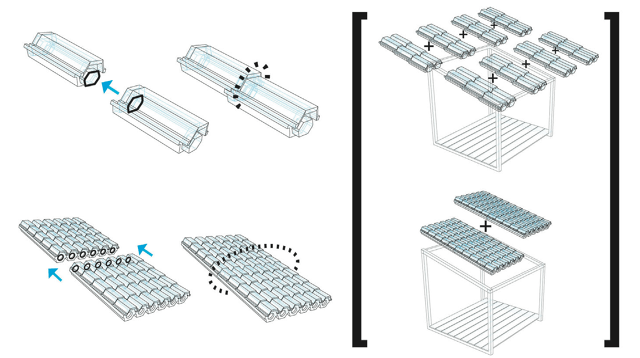 The modular nature of RMS' roofing is intended to make it easy to install and maintain. Courtesy of RMS.
In many parts of the world, roofing is constructed from cheap, easily replaceable materials such as corrugated iron. Not only do roofs made from these sorts of materials leak, they are completely inadequate for insulation, making them nearly useless for regulating temperature inside a dwelling. A corrugated iron roof will also rust through in around two years, leading to wasted resources.
RMS has an idea to change all that by offering inexpensive roofing to people around the world. Based on the appearance of terracotta tiles, the new roofing tiles are actually manufactured from recycled plastic. Plastic tiles last longer than corrugated metal, and are possible to replace or repair in small areas, rather than requiring a whole new roof.
From the website:
RMS addresses these [roofing material] problems through an easy to construct modular system composed of locally sourced materials. By having these features, the impact through the performance of our design aims to reduce the CO2 in production, save cost per unit, and reduce lifetime costs and capital expenditures through local sourcing and distribution.
 RMS would like to extend its program across the world in stages, starting with its pilot program in the Dominican Republic. Courtesy of RMS.
The design for new roofing includes two different types of tile. One is a 4x4-ft. slab that provides the primary roofing, and the other is a smaller tile meant to fill in gaps, and be useful for making repairs. The parts are interchangeable and interlocking. According to RMS, the roofing can be used to cover a 12x12-ft. room without requiring support.
AM enters the picture when it comes to building the smaller roofing tiles. It isn’t all that difficult to grind down plastic and form it into filament ready for use in a 3D printer. Most commonly available AM systems should be able to print out the small tiles, which will help keep a roof in working order. RMS is looking to work with local toy companies to build the larger pieces, which will be made with injection molding.
Below you’ll find a short video about RMS’ mission.


John Newman is a Digital Engineering contributor who focuses on 3D printing. Contact him via [email protected] and read his posts on Rapid Ready Technology.
Follow DE
Join over 90,000 engineering professionals who get fresh engineering news as soon as it is published.






About Us · Contact Us · Editorial Team · Advertising · Privacy Policy · Subscriber Services · © 2026 Digital Engineering 24/7 · Peerless Media