Helping design and engineering professionals discover, evaluate and specify technologies and processes that shorten the design cycle and enable success.


Alert!
Digital Engineering ceased publication on July 1, 2026. This website remains available as an archive of engineering content.
For inquiries or information, please email [email protected].

Digital Engineering April 2026
In the latest issue of Digital Engineering, we take a look at the latest innovations in design for additive manufacturing, including the use of natural language inputs, social media cosplayers, and AI integration. The issue also includes a feature…

January Special Focus Issue: Design for Additive
In this Special Focus Issue of Digital Engineering, learn about the latest advancements in design for additive manufacturing, including new software tools, additive in automotive, custom medical devices, and more.
Generally, octopi kind of meander along the bottom of the ocean by pulling themselves along with their multiple arms. When startled or attacked, an octopus sucks water into its mantle. The water is then squirted back out behind the octopus to propel it away from the source of trouble. Direction is determined by altering the funnel through which water travels.
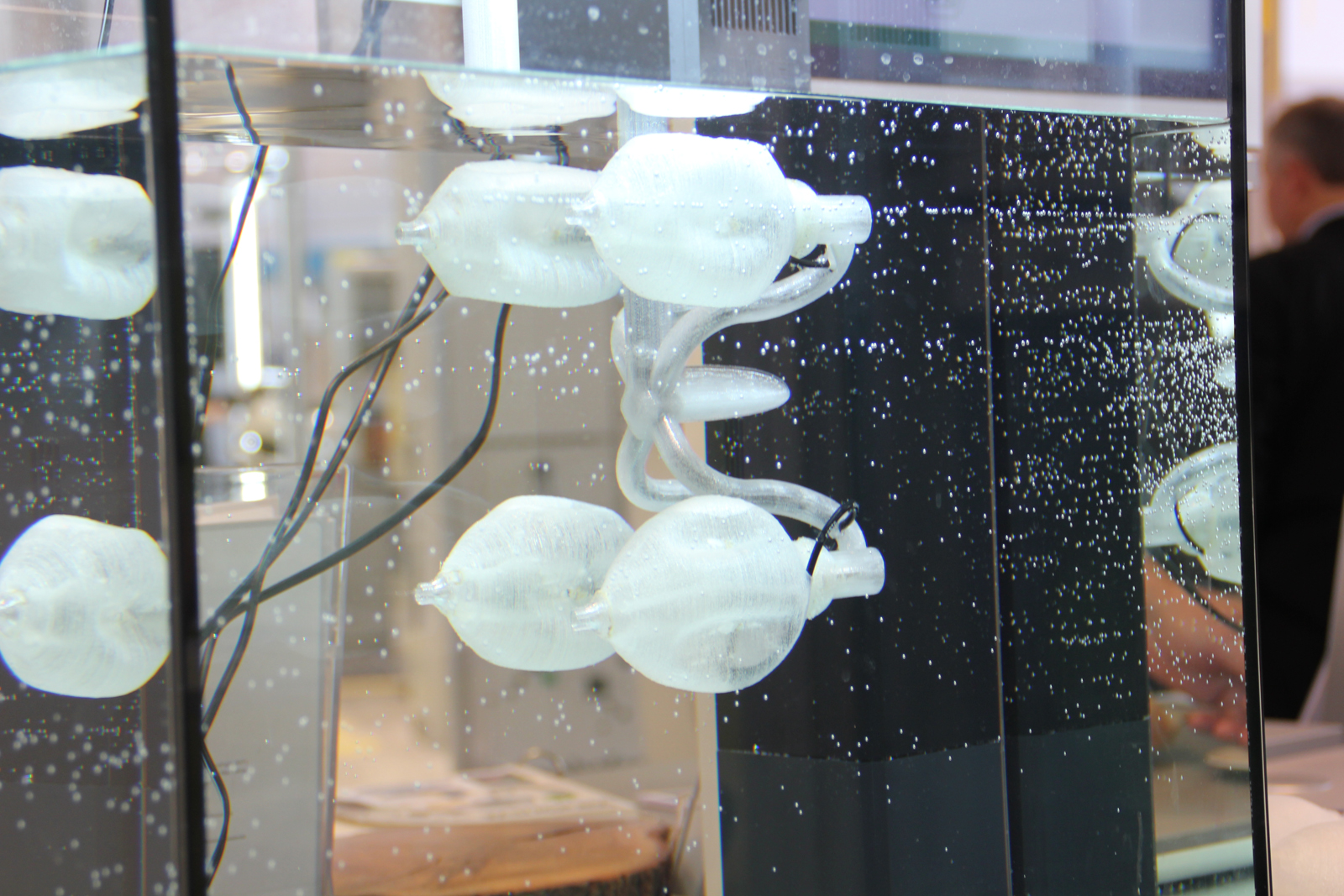
“Squids use this type of movement mainly if they are trying to flee suddenly and quickly. The system is simple, but effective. When they use it, the octopods can speed up considerably over short distances,” said Andreas Fischer, an engineer at the Fraunhofer Institute in Stuttgart. “We have integrated this propulsion principle into our underwater actuators: four elastomer balls with mechanical inner workings create propulsion by pumping water.”
To operate, water is drawn into an elastomer ball through an opening which is equipped with a recirculation valve to keep the water from escaping. A motor pump then operates a hydraulic piston, which flexes the mechanical version of an octopuses’ muscle, pushing the water back out of the ball. The system provides enough propulsion to maneuver small watercraft, including water sports equipment such as jet skis, and could also be used as a swim aid for divers.
Each 20x6 cm plastic ball is manufactured in one piece using additive manufacturing (AM), and, more specifically material extrusion. AM allows for the type of complex internal geometries required for the project. Use of AM also allows the potential to scale up the system for use on larger vessels. The research team at Fraunhofer chose materials such as polyurethane for its flexibility and durability.
In addition to being far quieter than traditional motor engines, the octopus-inspired propulsion system is also easier on sea life, or unfortunate humans that might fall overboard. This system of propulsion would also be much less expensive to repair or replace, requiring a single AM-built part in place of multiple mechanical bits and pieces.
Below you’ll find a short video about octopi.
Source: Fraunhofer Institute


John Newman is a Digital Engineering contributor who focuses on 3D printing. Contact him via [email protected] and read his posts on Rapid Ready Technology.
Follow DE






About Us · Contact Us · Editorial Team · Advertising · Privacy Policy · Subscriber Services · © 2026 Digital Engineering 24/7 · Peerless Media