Helping design and engineering professionals discover, evaluate and specify technologies and processes that shorten the design cycle and enable success.




May 2026 Special Focus: Artificial Intelligence in Design and Simulation
In this Special Focus Issue, learn about the latest developments in the integration of artificial intelligence into engineering workflows.

April 2026 Special Focus Issue: Generative Design
In this Special Focus Issue, Digital Engineering takes a look at how generative design solutions can be used across different types of design problems and with a variety of manufacturing approaches to accelerate design space exploration, and…
If you ever want to see otherwise calm, even-tempered adults descend into unhinged terror and panic, just watch the reaction when an average parent gets a note or call from the school about head lice.
These itchy parasites have been with us since mammals emerged on the Earth, and head lice as a distinct species may seems to have appeared around 100,000 years ago. The CDC estimates there are about 6 to 12 million infections each year among children 3-11 years of age, and as many as 74 million infestiations for kids under the age of 18, and a cottage industry has emerged to help get rid of them. FloSonix Ventures recently tapped Enventys Partners to help design and manufacture a new gadget for the lice wars, and 3D printing played a key role.
Over time, lice have built up an immunity to the common chemical and pesticide treatments used in the past to kill them. In response, a burgeoning industry has sprung up employing a wide variety of techniques. Because chemical treatments do not work reliably, the only way to really get rid of lice is to get physical: you have to kill the adults and manually remove all of the eggs (a tedious exercise in literal nit-picking). But killing lice is not easy. You can suffocate them with heavy oils (a cheap, but messy, method is to coat the scalp with olive oil). They can also be killed using heat, which is handy for hats and bed clothes, not so much for your third grader's head. According to Mordor Intelligence, the lice treatment market is growing at a healthy CAGR of 6.6% through 2026.
Enter FloSonix, which has created a sort-of mobile heat pump to kill lice eggs right on the scalp. The company approached Enventys because they needed to design and manufacture a new device with better ergonomics for end users. With a projected demand for 200-300 devices annually, and each device requiring many plastic components, the costs associated with traditional tooling, injection molding, and manufacturing were too high to make the device cost-effective. Enventys recommended additive manufacturing to better balance cost and quality.
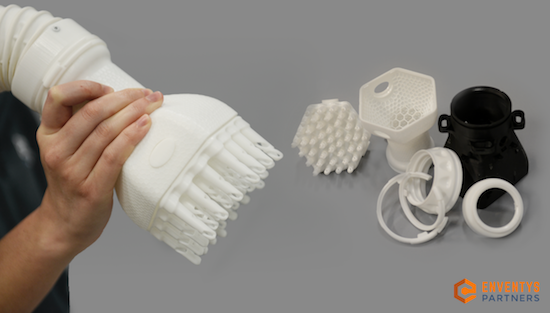
Because of the mechanical, aesthetic, and heat resistance properties required for the medical Enventys selected the Stratasys Origin One 3D printer.
"The Origin One 3D printer allowed us to make several initial options for our client to choose from and then make tiny tweaks almost in real-time without delaying the project or incurring huge expenses," said TJ Root, senior design engineer for Enventys Partners. "By prototyping on the same machine that will make the final parts, we had extreme confidence in every piece we were making."
Origin leveraged the materials portfolio of Henkel Loctite 3DP resins to meet the device requirements. Loctite 3D 3843, IND403 and MED413 matched FloSonix's requirements for toughness, temperature and color needs in a single device, providing high part dimensional stability and an exceptional surface finish. The final material is also sterilizable, allowing FloSonix to provide reusable tips for its customers instead of one-time-use consumables.
Texture designed in nTop software to improve device ergonomics while reducing material volume.
"We are excited to see this product come to market," said Ken Kisner, Henkel's Head of Innovation for 3D printing. "This application highlights the versatility of 3DP and the multitude of applications that Loctite 3DP materials can serve."
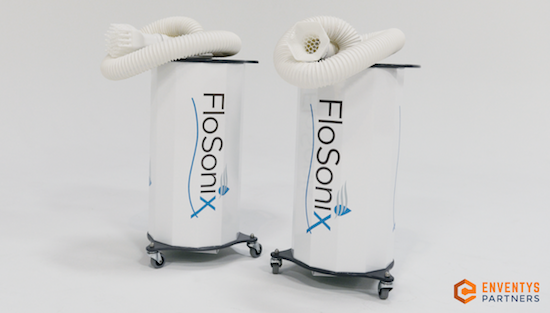
Using additive manufacturing also enabled more design freedom, including component consolidation, adding assembly features, and final tuning parameters to achieve better accuracy, the company says. According to Enventys, using a traditional method like injection molding would have increased the number of parts required, the assembly steps and the overall device cost. Additive also reduced the number of part suppliers for prototyping and final production. It also enabled the team to freeze some components' design and start their manufacture while still adjusting the final product.
"Enventys Partners' approach to this application is incredibly innovative and an ideal process for any brand taking a complex mid-volume product to market quickly and economically," said Christopher Prucha, co-founder of Origin and now the head of the Origin team at Stratasys. "By using an additive first approach; combining parts, designing custom textures, and taking advantage of Origin One's material selection and final part quality, they've created a playbook for product development using additive manufacturing."
Sources: Press materials received from the company and additional information gleaned from the company’s website.


Every day, our customers find simpler, smarter approaches to stubborn design problemsand greater confidence to confront towering human and technological challenges. Less hindered by the usual constraints, they can imagine, design, iterate and…
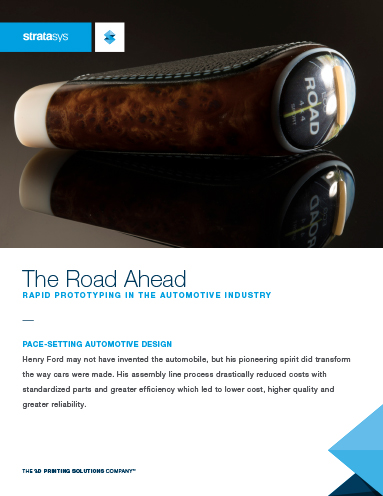
Rapid Prototyping in The Automotive Industry
Henry Ford may not have invented the automobile, but his pioneering spirit did transform the way cars were made. His assembly line process drastically reduced costs with standardized parts and greater efficiency which led to lower cost, higher quality and greater reliability.

Brian Albright is the editorial director of Digital Engineering.
Contact him at [email protected].

Join over 90,000 engineering professionals who get fresh engineering news as soon as it is published.






About Us · Contact Us · Editorial Team · Advertising · Privacy Policy · Subscriber Services · © 2026 Digital Engineering 24/7 · Peerless Media