Helping design and engineering professionals discover, evaluate and specify technologies and processes that shorten the design cycle and enable success.



Digital Engineering April 2026
In the latest issue of Digital Engineering, we take a look at the latest innovations in design for additive manufacturing, including the use of natural language inputs, social media cosplayers, and AI integration. The issue also includes a feature…

January Special Focus Issue: Design for Additive
In this Special Focus Issue of Digital Engineering, learn about the latest advancements in design for additive manufacturing, including new software tools, additive in automotive, custom medical devices, and more.
A better solution, and one long foreseen by science fiction writers, is to use the natural resources offered by space. Rather than spend $50 million for every ton sent into space, companies like Planetary Resources are mapping out workable solutions to gathering and working raw materials gathered from existing resources, such as near-Earth asteroids. 3D Systems, and its expertise with additive manufacturing (AM), has become an important part of the process.
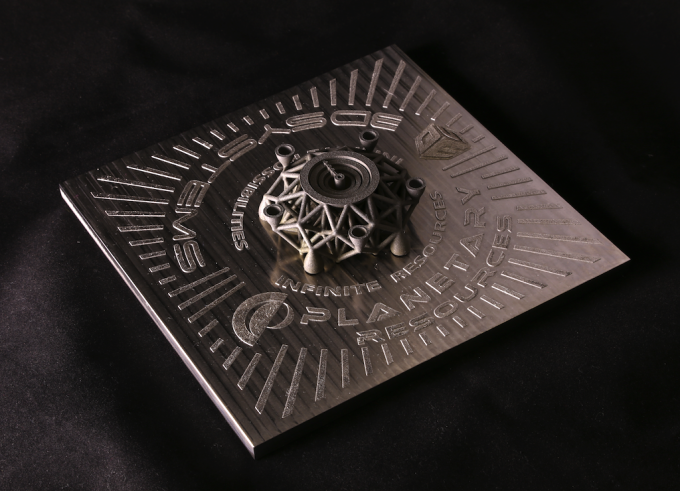
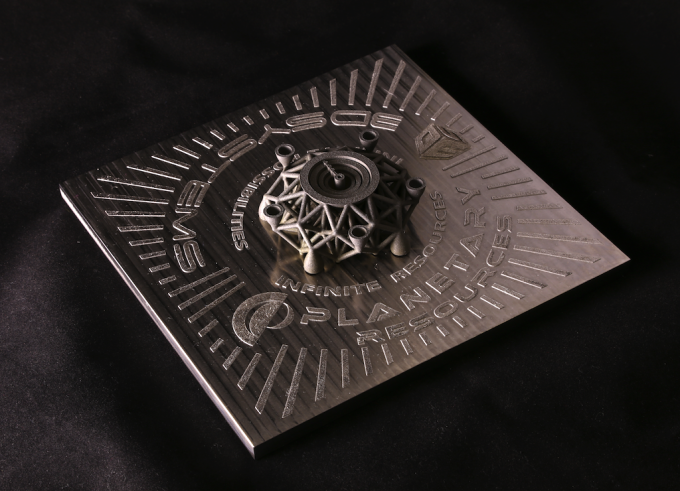 The first object every created using 3D printing and meteoric materials. Courtesy of Planetary Resources.
To determine which, if any, of the near-Earth asteroids might be considered prime real estate for mining operations, Planetary Resources is developing a series of robotic survey craft. The small survey craft will be piggyback on larger space-bound craft, launching off on their own missions once they reach space. Planetary Resources has embraced AM in order to speed up the design process of its surveyors.
“3D printing enables us to experiment with design concepts and produce better-functioning production parts much quicker, without worrying about the processes involved with traditional manufacturing,” said Chris Lewicki, president and CEO of Planetary Resources. “3D printing has come of age and we believe it represents the future of aerospace manufacturing.”
Planetary Resources has already developed two test craft, one of which was sent into space last fall. The test craft are about the size of a cereal box, and were sent out to test the basic design and onboard systems. The actual survey robots will be about double the size of the test models and will weigh around 30 lbs.
In addition to leveraging AM to speed up design iterations, 3DS and Planetary Systems recently collaborated in an experiment using meteoric metals with 3D printing. The materials were harvested from a meteorite that landed in Argentina, composed of iron, nickel and cobalt. A fragment of the meteorite was crushed, and the resulting metallic powder was used to fuel 3DS’ ProX DMP 320 metals 3D printer. The test was successful, resulting in the first object ever built using 3D printing and meteoric materials.
Below you’ll find a video about Planetary Resources.
Sources: 3DS, Planetary Resources


John Newman is a Digital Engineering contributor who focuses on 3D printing. Contact him via [email protected] and read his posts on Rapid Ready Technology.
Follow DE
Join over 90,000 engineering professionals who get fresh engineering news as soon as it is published.






About Us · Contact Us · Editorial Team · Advertising · Privacy Policy · Subscriber Services · © 2026 Digital Engineering 24/7 · Peerless Media