Helping design and engineering professionals discover, evaluate and specify technologies and processes that shorten the design cycle and enable success.




May 2026 Special Focus: Artificial Intelligence in Design and Simulation
In this Special Focus Issue, learn about the latest developments in the integration of artificial intelligence into engineering workflows.

April 2026 Special Focus Issue: Generative Design
In this Special Focus Issue, Digital Engineering takes a look at how generative design solutions can be used across different types of design problems and with a variety of manufacturing approaches to accelerate design space exploration, and…
The outer layer of the human brain (the cerebral cortex) is lined with folds and grooves. Exactly how and why the brain grows and develops folds in that manner has puzzled scientists for years. According to the researchers, conventional wisdom held that this patterning was a purely biological phenomena.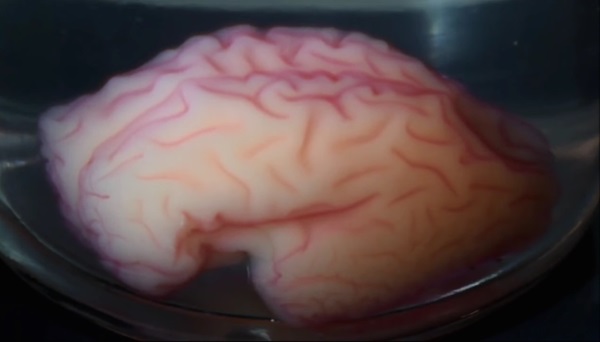
Lakshminarayanan Mahadevan, a physicist and applied mathematician at Harvard, wanted to study the physics of brain development. However, there was no way to ethically study growing human brains, and the brains of typical lab animals (like rats) don’t develop folds.
Using magnetic resonance imagery from a smooth fetal brain, they then 3D-printed a cast to make a gel model in two layers to represent the inner "white matter" and outer "gray matter" of a brain.
They submerged the brain model in a solvent that caused the outer “cortex” layer to expand. As they observed, folds began to form on the surface. What causes this? Their theory is that the cortex natural wants to continue growing, but the fact that it is anchored to the underlying white matter of the brain causes it to collapse.
Mahadevan next wants to study the link between the physical process and the molecular changes going on during brain development.
“In the end, all of them are related,” Mahadevan said. “If I think about the shape of the folds in a fetal brain then yes, there are molecular processes: There are biochemical processes which cause cells to move, cause cells to divide, cause cells to change shape and cause cells to change in number.”
The research could eventually point to a better understanding of neurological conditions like autism, Alzheimer’s disease, and schizophrenia.
You can read the original research in Nature Physics here. There’s also a nice explanation in this article over at the L.A. Times, and a video below.
Source: L.A. Times


Brian Albright is the editorial director of Digital Engineering.
Contact him at [email protected].

Join over 90,000 engineering professionals who get fresh engineering news as soon as it is published.






About Us · Contact Us · Editorial Team · Advertising · Privacy Policy · Subscriber Services · © 2026 Digital Engineering 24/7 · Peerless Media