Helping design and engineering professionals discover, evaluate and specify technologies and processes that shorten the design cycle and enable success.


Alert!
Digital Engineering ceased publication on July 1, 2026. This website remains available as an archive of engineering content.
For inquiries or information, please email [email protected].

Digital Engineering April 2026
In the latest issue of Digital Engineering, we take a look at the latest innovations in design for additive manufacturing, including the use of natural language inputs, social media cosplayers, and AI integration. The issue also includes a feature…

January Special Focus Issue: Design for Additive
In this Special Focus Issue of Digital Engineering, learn about the latest advancements in design for additive manufacturing, including new software tools, additive in automotive, custom medical devices, and more.
The report, "3D Printing 2015-2025: Technologies, Markets, Players," also evaluates which sectors are growing the fastest.
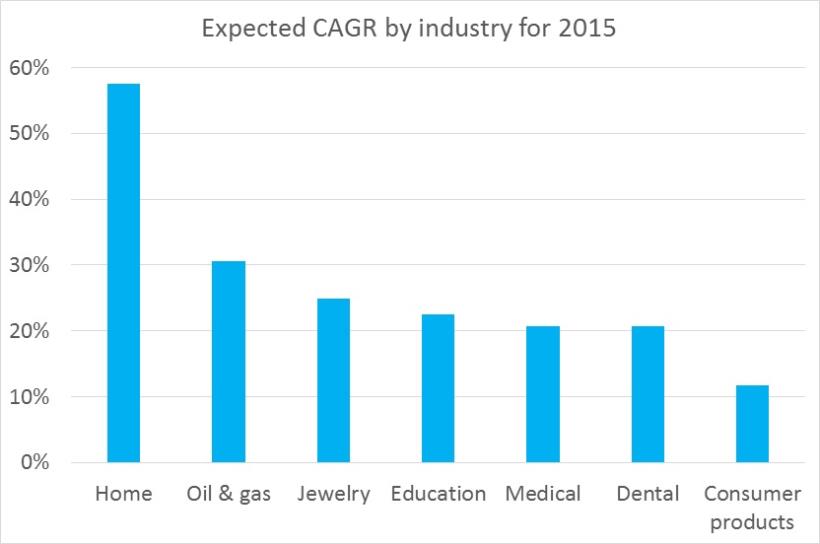 Short-term growth rates for 3D printing market sectors. Image: IDTechEx
According to the report, more than 60% of 3D printing revenues come from mid-range printers in the $30,000 to $300,000 range, which are used primarily for prototyping. That segment of the market, however, is experiencing the slowest growth because of the maturity of the applications.
The biggest growth areas now are in consumer-level printers under $3,000, and in metal printers that cost more than $300,000.
The consumer end of the market has received the most hype, although the researchers express some doubt that those levels are sustainable given the limited capabilities of the current printers. Because 3D printers are treated much like power tools, the report states:
The addressable market is then a fraction of the global home power tool market which is growing at around 5% per annum, much slower than the 100% growth in sales of consumer-level 3D printers from 2013 to 2014. Therefore, we expect the consumer market for 3D printing to start to saturate in the next few years and never exceed the global home power tool market.
Sales of high-end printers for manufacturing are being driven by use in aerospace (for production parts) and other industries. Oil and gas is the fastest growing industrial sector for these printers, with companies using the technology to create repair parts in remote or hostile locations. Another big growth areas will be 3D printed electronics, although there wasn't enough data available to provide a growth forecast for that segment.
Research and Markets has also released a new report titled "3D Printing Market (Material, Technology, Application): Global Insight (2014-2022)," which evaluates vertical market adoption of 3D printing.
According to that report, the consumer lifestyle and products and electronic sector had the highest market revenue (more than $384.80 million in 2013) with a CAGR of 21.6% through 2022, reaching $2.9 billion. The healthcare sector generated $319.04 million in revenue, while aerospace and defense stood at $300.57 million.
In terms of materials, photopolymers generated more than $239 million in revenue (and should see a CAGR of 6.97%). Metal had the lowest share ($27.10 million) but the highest CAGR (22.19%).
Source: IDTechEx and Research and Markets


Brian Albright is the editorial director of Digital Engineering.
Contact him at [email protected].






About Us · Contact Us · Editorial Team · Advertising · Privacy Policy · Subscriber Services · © 2026 Digital Engineering 24/7 · Peerless Media