Helping design and engineering professionals discover, evaluate and specify technologies and processes that shorten the design cycle and enable success.


Sponsored
 Dear Desktop Engineering Reader:
As I assayed the confections at some Ye Olde Candy Shoppe tourist trap, this little dude caught my eye. He was frozen in place, mouth agape and eyes bulging while examining all the sweets in front of him. So many choices, so little time. Adorable.
What’s not adorable is when analysis paralysis hits as you assess the capabilities of 3D printing service bureaus. You have so many 3D printing technologies and material choices and so little time to make your project deadlines that figuring out what’s best for the job can be quite a challenge. At the other end of today’s Check it Out link lies help sorting out your 3D printing material options.
“3D Printing Materials: Choosing the Right Material for Your Application,” a new white paper from Stratasys Direct Manufacturing, has the information you need to make an educated decision when selecting additive manufacturing technologies and materials for your prototypes or end-use parts. The paper focuses on working with a service bureau, but its wealth of information applies to most additive manufacturing applications.
The paper explains the advantages, disadvantages and best-case applications for photopolymers, powdered plastics, metal and thermoplastic 3D printing materials. It does so within the context of assessing the pros and cons of the five major 3D printing technologies: PolyJet, Stereolithography, Laser Sintering, Direct Metal Laser Sintering and Fused Deposition Modeling.
The information comes from an application point of view and is equally engineering- and design-centric. For engineers, material details cover minimum layer thicknesses, heat deflection, elongation at break, tolerances and so on. For designers, the paper provides tips throughout. A concise sidebar, “Material Selection Considerations,” combines several miscellaneous, but crucial concerns, like post-processing and material certifications.
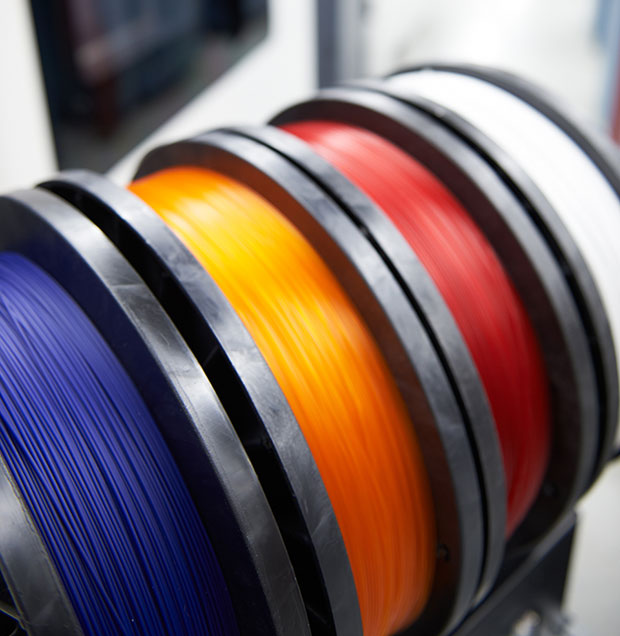 The additive manufacturing technology you choose defines the materials you can use for your job at hand.
Perhaps the foremost reason that “Choosing the Right Material” could become your go-to reference guide to 3D printing materials is its appendix. Here, you’ll find four charts matching the materials covered in the paper with their corresponding 3D printing technology. Each material details key specifications, like ultimate hardness, flexural modulus and so forth.
“3D Printing Materials: Choosing the Right Material for Your Application” is a well-done document. It was produced by the hands-on whizzes at Stratasys Direct Manufacturing, the 3D printing and advanced manufacturing services division of Stratasys. The information it conveys should help every engineer and designer make the right material choice for their 3D printing applications. Hit today’s Check it Out link to get your complimentary copy.
Thanks, Pal. – Lockwood
Anthony J. Lockwood
Editor at Large, Desktop Engineering
Download a copy of "3D Printing Materials: Choosing the Right Material for Your Application" here.


Anthony J. Lockwood is Digital Engineering's founding editor. He is now retired. Contact him via [email protected].
Follow DE
Join over 90,000 engineering professionals who get fresh engineering news as soon as it is published.






About Us · Contact Us · Editorial Team · Advertising · Privacy Policy · Subscriber Services · © 2026 Digital Engineering 24/7 · Peerless Media