Helping design and engineering professionals discover, evaluate and specify technologies and processes that shorten the design cycle and enable success.


Sponsored

Digital Engineering April 2026
In the latest issue of Digital Engineering, we take a look at the latest innovations in design for additive manufacturing, including the use of natural language inputs, social media cosplayers, and AI integration. The issue also includes a feature…

January Special Focus Issue: Design for Additive
In this Special Focus Issue of Digital Engineering, learn about the latest advancements in design for additive manufacturing, including new software tools, additive in automotive, custom medical devices, and more.
While recovering from a broken ankle in 2008, Alex Berry, Founder and Engineering Director of Sutrue, first came up with the idea of an automated suturing device for minimally invasive surgery.
Minimally invasive surgery offers patients reduced recovery times, better outcomes, and fewer complications. However, the limited availability of instruments suited for this type of small and very precise task impedes the surgeon’s abilities to offer their patients minimally invasive options.
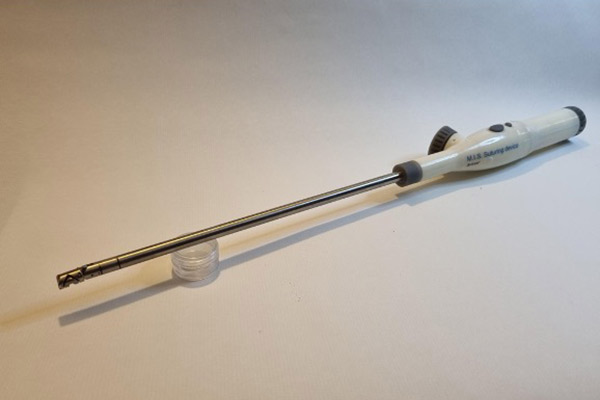
Sutrue’s minimally invasive suturing device is designed specifically in mind for keyhole surgery – both laparoscopic and robotic. Suturing is one of the fundamental duties of surgeons, and yet there is not instrument available that enables their performance on the scale necessary for minimally invasive (8mm diameter). Sutrue’s innovative design addresses this gap, and the small size of the prototype devices require extreme accuracy.
After years of research and experimenting, Berry’s team designed a device that operates by passing a suturing needle and thread through tissue and returning into the device securely. The needle rotates out and back into the device on a fixed path while staying level on the third axis. The team had prototypes of the device machined from steel, which required a significant amount of time and could not easily accommodate design iterations.
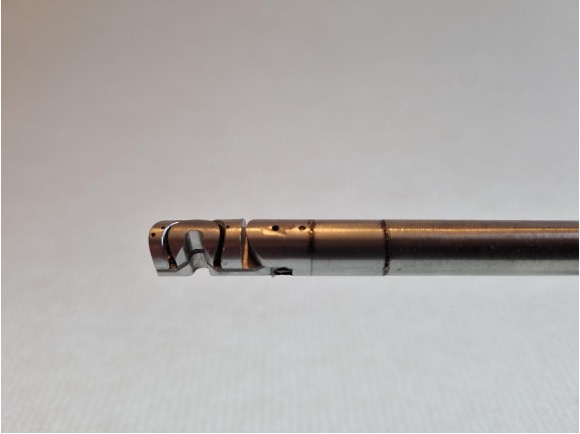
While developing the suturing device, Berry’s team needed to update one of the most important device components, relating to the stability of the needle’s path. Machining the part again would have delayed testing the product by several months and cost a significant amount of money. Machining also left no room for experimentation as the team would only be able to receive one replacement design.
3D printing the replacement parts allowed the team to test different versions of the part with small differences to test various tolerances in a short timeframe. Additionally, working with 3D printing also allowed the team to consider aesthetics, having the parts printed in two different colors.
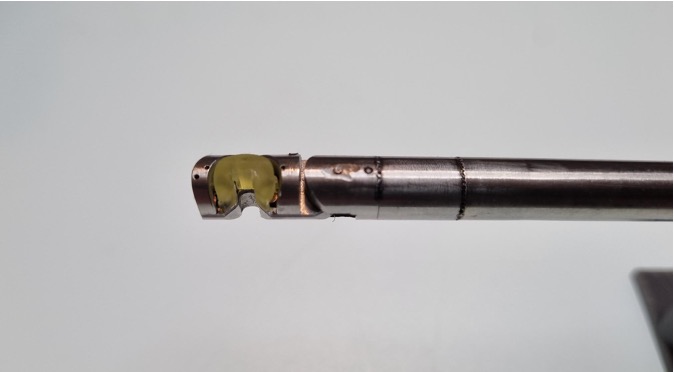 Sutrue's device with the 3D Printed component.
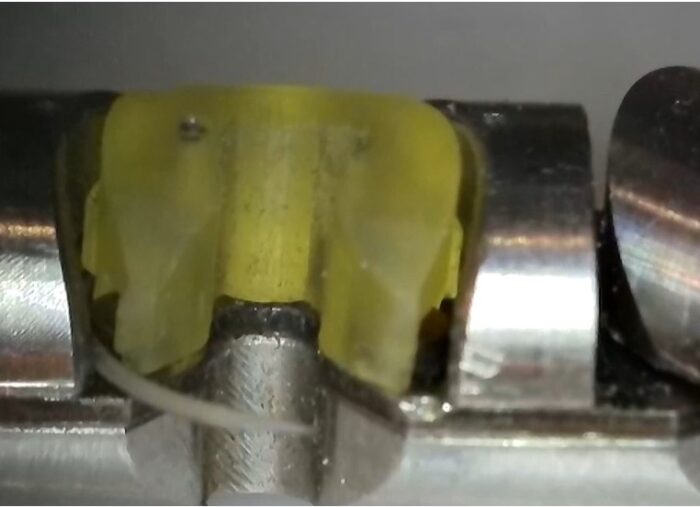 3D printed component to stabilize the needle path.
Alex Berry, Founder and Engineering Director at Sutrue:
"The accuracy of BMF printers at small scale means that we could try three different parts to find the ideal fit. This allowed for our device to finally function as designed without the cost and time delay of machining the part. This has led to us being able to do initial testing and advance the development of a unique medical device with the assurance that the BMF printed parts are true to the design and consistently accurate."
Advances in medical devices will continue to expand the availability of minimally invasive surgery. The ability to 3D print prototypes at the resolution, size, and tolerance of precision injection molded parts opens up the possibilities for advancements in the instruments required for minimally invasive procedures.
To learn more about micro 3D printing applications for instruments needed for minimally invasive surgery, contact BMF.


Boston Micro Fabrication is the world leader in micro-precision 3D printers utilizing Projection Micro Stereolithography (PµSL) technology. Many leading companies worldwide are adopting PµSL to 3D print true microstructures with ultra-high…

Ultra-high Accuracy, Precision, and Resolution Micro 3D Printed Medical Device Manufacturing
Discover how the use of micro-precision 3D printing is aiding medical device producers to tackle two common issues through this white paper.

Join over 90,000 engineering professionals who get fresh engineering news as soon as it is published.






About Us · Contact Us · Editorial Team · Advertising · Privacy Policy · Subscriber Services · © 2026 Digital Engineering 24/7 · Peerless Media