Helping design and engineering professionals discover, evaluate and specify technologies and processes that shorten the design cycle and enable success.



Digital Engineering April 2026
In the latest issue of Digital Engineering, we take a look at the latest innovations in design for additive manufacturing, including the use of natural language inputs, social media cosplayers, and AI integration. The issue also includes a feature…

January Special Focus Issue: Design for Additive
In this Special Focus Issue of Digital Engineering, learn about the latest advancements in design for additive manufacturing, including new software tools, additive in automotive, custom medical devices, and more.
The key to these procedures is the use of two-photon polymerization, which is capable of building nano scale structures. A potential issue with building these structures from polymers is the tendency for the materials to be toxic. Researchers at North Carolina State University (NC State) may have discovered a way to overcome this hazard by building the nano structures using riboflavin (AKA vitamin B2).
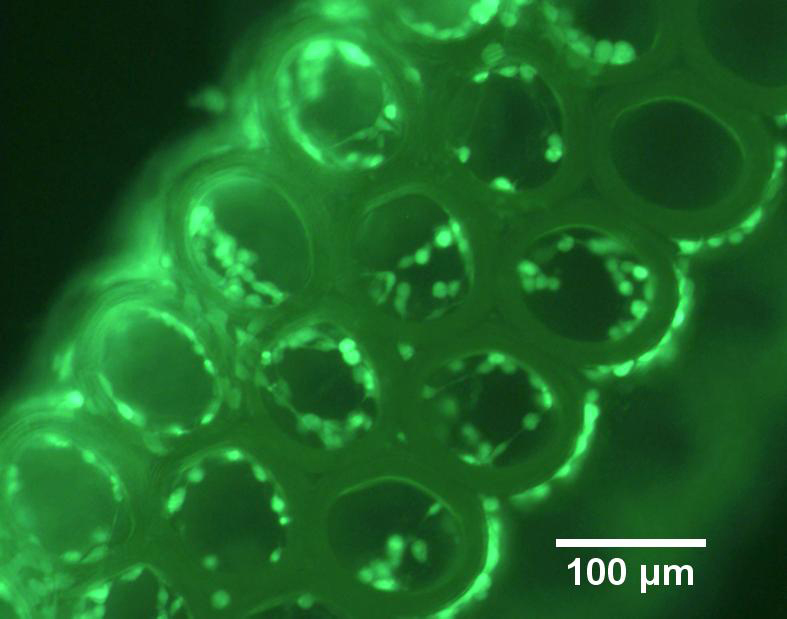
By mixing riboflavin with a precursor material, researchers have made the naturally occurring compound photosensitive, allowing it to be shaped by the two-photon process. Found in everything from asparagus to cottage cheese, riboflavin is nontoxic and biocompatible, making it an ideal candidate for use in patients.
“This opens the door to a much wider range of biocompatible implant materials, which can be used to develop customized implant designs using 3D printing technology,” said Dr. Roger Narayan, senior author of a paper describing the work and a professor in the joint biomedical engineering department at NC State and UNC-Chapel Hill.
Tests have thus far proved promising. Compared to standard polymers, riboflavin-based scaffolds were more compatible with living cells, allowing more cells to survive the implant process. While NC State researchers have admitted that the riboflavin mix used to build the scaffolds isn’t as easy to work with as polymer materials, they are confident that this shortcoming can be overcome.
More work, along with standard approval procedures, needs to be completed before the implants are ready to be used in medical implants, but this breakthrough could become extremely important for the future of medical 3D printing. The research was published online in Regenerative Medicine, under the title “Two-photon polymerization of polyethylene glycol diacrylate scaffolds with riboflavin and triethanolamine used as a water-soluble photoinitiator.”
Below you’ll find a short video about the riboflavin implants.
Sources: LiveScience, NC State


John Newman is a Digital Engineering contributor who focuses on 3D printing. Contact him via [email protected] and read his posts on Rapid Ready Technology.
Follow DE
Join over 90,000 engineering professionals who get fresh engineering news as soon as it is published.






About Us · Contact Us · Editorial Team · Advertising · Privacy Policy · Subscriber Services · © 2026 Digital Engineering 24/7 · Peerless Media