Helping design and engineering professionals discover, evaluate and specify technologies and processes that shorten the design cycle and enable success.



Digital Engineering April 2026
In the latest issue of Digital Engineering, we take a look at the latest innovations in design for additive manufacturing, including the use of natural language inputs, social media cosplayers, and AI integration. The issue also includes a feature…

January Special Focus Issue: Design for Additive
In this Special Focus Issue of Digital Engineering, learn about the latest advancements in design for additive manufacturing, including new software tools, additive in automotive, custom medical devices, and more.
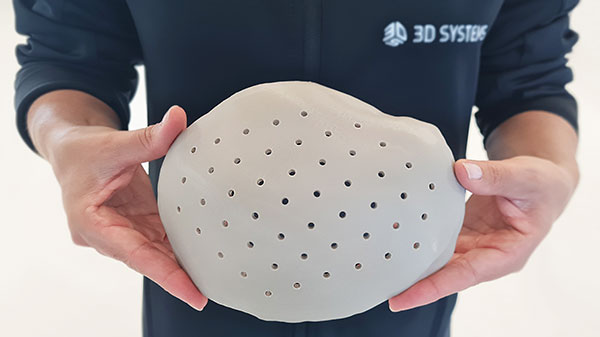
3D Systems reports the U.S. Food and Drug Administration (FDA) has provided 510(k) clearance for its 3D-printed, patient-specific cranial implant solution — VSP PEEK Cranial Implant.
VSP PEEK Cranial Implant includes a FDA-cleared workflow comprising segmentation and 3D modeling software, the 3D Systems EXT 220 MED 3D printer, Evonik VESTAKEEP i4 3DF PEEK (polyetheretherketone), and a predefined production process. By using additive manufacturing solutions, this technology can reportedly produce patient-specific cranial implants with notably less material than similar implants produced by traditional machining.
The cleanroom-based architecture of the printer combined with post-processing workflows makes it a technology beneficial for producing patient-specific medical devices at the hospital site with faster turnaround, the company reports. To date, this solution has been used to enable nearly 40 successful cranioplasties in Switzerland at University Hospital Basel, in Austria at Salzburg University Hospital, and in Israel at Tel-Aviv Sourasky Medical Center.
The VSP PEEK Cranial Implant is a FDA-cleared, additively manufactured PEEK implant intended for cranioplasty procedures to restore defects in the skull. This implant-grade, high-performance polymer has biocompatibility, resistance to bodily fluids, and stability in a wide range of temperatures, making it useful for many medical device applications, according to 3D Systems. Its inherent radiolucency ensures minimal interference in medical imaging, facilitating a clearer evaluation of the surgical site and implant integrity, the company adds.
“Receiving FDA clearance for our VSP PEEK Cranial Implant solution is a significant milestone in our journey," says Dr. Gautam Gupta, senior vice president and general manager, medical devices, 3D Systems. "With this FDA clearance, we are now able to bring VSP PEEK Cranial Implant to the U.S.—setting a new standard of excellence for these procedures. We are now looking to the next applications for this technology, which includes 3D-printed spine interbody fusion implants, carbon fiber-reinforced PEEK for plating applications in trauma and fixation, and bioresorbable polymers for large bone and craniomaxillofacial applications.”
It is anticipated that the use of 3D-printed cranial implants will accelerate, according to 3D Systems, based on the availability of advanced technologies. According to a report by Acumen Research and Consulting in February 2023, the cranial implants market size in 2021 was roughly $1.2 billion and is anticipated to approach $2.1 billion by 2030. Cranial implants can address a breadth of applications including trauma, defects, and reconstruction.
Sources: Press materials received from the company and additional information gleaned from the company’s website.

From digitization, design and simulation through manufacturing, inspection and management, our comprehensive portfolio of technologies provides a seamless, customizable workflow designed to optimize products and processes while accelerating…
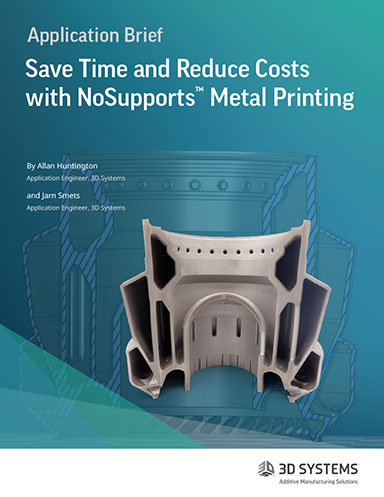
Save Time and Reduce Costs with NoSupports™ Metal Printing
Metal 3D printing is a high energy process in which it is possible for unmanaged heat and stress to build up and impact part quality, this guide presents a step-by-step methodology for how to apply NoSupports to a hot end section of a larger turbomachinery part.

DE's editors contribute news and new product announcements to Digital Engineering. Press releases may be sent to them via [email protected].
Follow DE
Join over 90,000 engineering professionals who get fresh engineering news as soon as it is published.






About Us · Contact Us · Editorial Team · Advertising · Privacy Policy · Subscriber Services · © 2026 Digital Engineering 24/7 · Peerless Media