Helping design and engineering professionals discover, evaluate and specify technologies and processes that shorten the design cycle and enable success.


Alert!
Digital Engineering ceased publication on July 1, 2026. This website remains available as an archive of engineering content.
For inquiries or information, please email [email protected].

Digital Engineering April 2026
In the latest issue of Digital Engineering, we take a look at the latest innovations in design for additive manufacturing, including the use of natural language inputs, social media cosplayers, and AI integration. The issue also includes a feature…

January Special Focus Issue: Design for Additive
In this Special Focus Issue of Digital Engineering, learn about the latest advancements in design for additive manufacturing, including new software tools, additive in automotive, custom medical devices, and more.
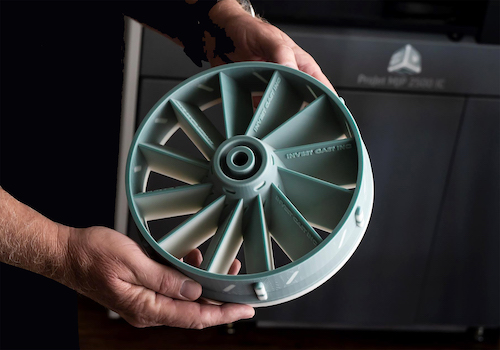
Investment casting, a centuries-old process used for myriad part types across many industries, is being catapulted into the digital age with a new 3D printing solution from 3D Systems.
The company’s ProJet MJP 2500 IC, built on the ProJet 2500 platform, has been tuned specifically for the production of metal cast components, a market valued at nearly $14 billion per year, driven by significant demand for parts production by the commercial aircraft industry. The ProJet MJP 2500 IC eliminates the need to create injection-molded tooling, reducing the time to create these types of commonly produced RealWax patterns. The result: accelerated time to market and a reduction in production costs thanks to the tool-less production approach.
“Instead of having to engage a foundry to product injection molds to produce wax patterns, you can now print them directly,” explains Mike Stanicek, vice president, product management, plastics for 3D Systems. “Since you don’t have to take the time or expense to create molds, you can produce parts quicker, removing any lead time.”
Given the flexibilities and design freedom afforded by 3D printing, engineering organizations can also create more complex parts that were not possible with injection molding practices, Stanicek says. Specifically, digital design allows for wax patterns for parts that take advantage of topology optimization, lightweighting, and parts consolidation—production strategies that aren’t possible with traditional methods.
Along with accelerated time to production and time to market advantages, the ProJet MJP 2500 IC is much more economical than traditional wax pattern methods because there is no requirement to build advanced tooling. Typical production time for a 3D printed wax pattern is a few hours or less, officials claim, and there is no longer a requirement (or time and money spent) on the injection molding process associated with traditional methods. In one cost comparison analysis conducted for 3D Systems by partner Mueller Additive Manufacturing Solutions, a pattern tool for a mechanical cam cost $6,050 compared the 3D printed equivalent pattern, which was completed for under $25.
Another benefit of the ProJet MJP 2500 IC is that it’s been architected to fit into the design process without requiring any additional training. The 3D Sprint software helps streamline a file-to-pattern workflow. Officials claim a relatively straightforward printer setup that takes about five hours from uncrating the printer to part production.
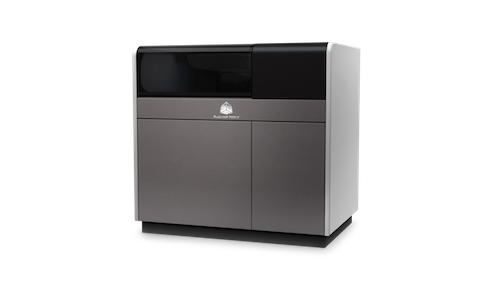
Given the time, cost, and ease-of-use benefits, 3D Systems expects the system to be leveraged for a variety of use cases, including customized metal components, bridge manufacturing needs, and low-volume production. Stanicek also sees the printer improving the design workflow, enabling engineers to explore and test more design iterations to optimize performance of a part.
“Before you might have four alternatives, but you’d have to wait four to six weeks for each to produce a mold, in addition to the costs,” he explains. “[With the ProJet MJP 2500 IC], you can print six potential part designs in the same print run, do the testing, and optimize the results for a final design. It speeds time to market on the first parts and enables parts and geometries that just weren’t possible previously.”
Watch this video to see the new printer in action.

From digitization, design and simulation through manufacturing, inspection and management, our comprehensive portfolio of technologies provides a seamless, customizable workflow designed to optimize products and processes while accelerating…
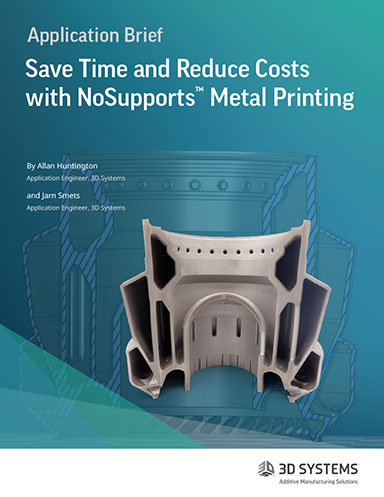
Save Time and Reduce Costs with NoSupports™ Metal Printing
Metal 3D printing is a high energy process in which it is possible for unmanaged heat and stress to build up and impact part quality, this guide presents a step-by-step methodology for how to apply NoSupports to a hot end section of a larger turbomachinery part.

Beth Stackpole is a contributing editor to Digital Engineering. Send e-mail about this article to [email protected].
Follow DE






About Us · Contact Us · Editorial Team · Advertising · Privacy Policy · Subscriber Services · © 2026 Digital Engineering 24/7 · Peerless Media