Helping design and engineering professionals discover, evaluate and specify technologies and processes that shorten the design cycle and enable success.




Digital Engineering April 2026
In the latest issue of Digital Engineering, we take a look at the latest innovations in design for additive manufacturing, including the use of natural language inputs, social media cosplayers, and AI integration. The issue also includes a feature…

January Special Focus Issue: Design for Additive
In this Special Focus Issue of Digital Engineering, learn about the latest advancements in design for additive manufacturing, including new software tools, additive in automotive, custom medical devices, and more.
3D Systems (3DS) has been hard at work developing tools that might allow it to meet that very goal. The company took its first steps toward mass manufacturing while developing Project Ara, but its new, developmental industrial AM system is far more ambitious. Based on 3DS’ tried-and-true stereolithography (SLA) process, its Figure 4 technology aims to bring 3D printing to the factory floor with the modular SLAbot-2.
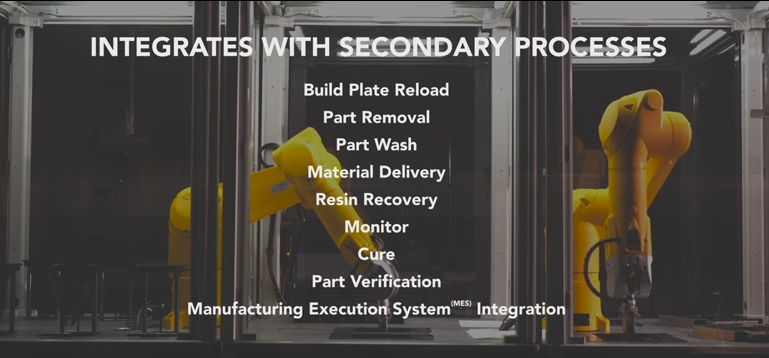 The addition of automation offers a number of potential advantages to the AM process. Courtesy of 3DS.
Unlike some AM systems such as the BAAM system that look to produce large objects in quantity without much worry to initial strata lines, Figure 4 is focused on producing a quantity of parts-sized objects with high resolution. 3DS claims its new system is up to 50x faster than existing systems, while still retaining the fine detail characteristic of SLA prints.
Speed of printing opens up new material possibilities, based on the idea that it’s possible to create less stable vats of material because the materials can have an active life of days or hours instead of years. According to the company, this allows for hybrid photopolymers designed for toughness, durability, bio-compatibility, high temperature deflection and elastomeric properties.
Another change with Figure 4, and the SLAbot-2 is the standard inclusion of a robot arm to assist with the manufacturing process. The arm is responsible for loading and unloading trays into and out of material vats, which allows several build processes to run simultaneously. Additionally, the arm moves completed builds from the vats to automated cleaning and post-processing stations, allowing for continuous parts production without requiring human intervention.
Each SLAbot-2 essentially acts as a modular station. By combining multiple stations, you create a robotic production line that (theoretically) further speeds up the rate of production by allowing the arms to assist each other with manufacturing duties. CAD data and materials go in one end, finished parts come out the other. Changing the line over to produce different parts is as simple as changing the CAD files, which offers significant savings over injection molding where new parts mean new molds.
Below you’ll find a video about Figure 4.
Source: 3DS


John Newman is a Digital Engineering contributor who focuses on 3D printing. Contact him via [email protected] and read his posts on Rapid Ready Technology.
Follow DE
Join over 90,000 engineering professionals who get fresh engineering news as soon as it is published.






About Us · Contact Us · Editorial Team · Advertising · Privacy Policy · Subscriber Services · © 2026 Digital Engineering 24/7 · Peerless Media