Helping design and engineering professionals discover, evaluate and specify technologies and processes that shorten the design cycle and enable success.


Sponsored

May 2026 Special Focus: Artificial Intelligence in Design and Simulation
In this Special Focus Issue, learn about the latest developments in the integration of artificial intelligence into engineering workflows.

Design & Simulation Software Guide 2025
In this Special Issue, Digital Engineering presents its second annual guide to design and simulation software vendors.

 Dear DE Reader:
Not so long ago many manufacturers held the very idea of a milling machine and a 3D printer on the floor together as preposterous as Ares and Wonder Woman dancing the bolero. But reality, money and time have this way of changing tunes. It's happening. Still a wallflower on this notion? Then read today's Check it Out white paper.
Money, pro-level desktop 3D printers and strong 3D print materials are key partners in this trend. Simply put, if at all possible, you're not going to tie up your CNC (computer numerical control) mill or buy a new one to handle tiny volumes or do some one-off tooling. The money and ROI (return on investment) aren't there.
Desktop 3D printers, however, handle small runs and one-offs with aplomb, are affordable and can have a fast ROI. Most importantly, the part strength and accuracy you can get out of 3D print materials not only makes small jobs cost-effective, they keep your CNC producing the stuff it does best. That's the premise of Markforged's new “5 Ways to Increase Bandwidth on Your CNC Mill with a Desktop 3D Printer” white paper. It's a good and convincing read.
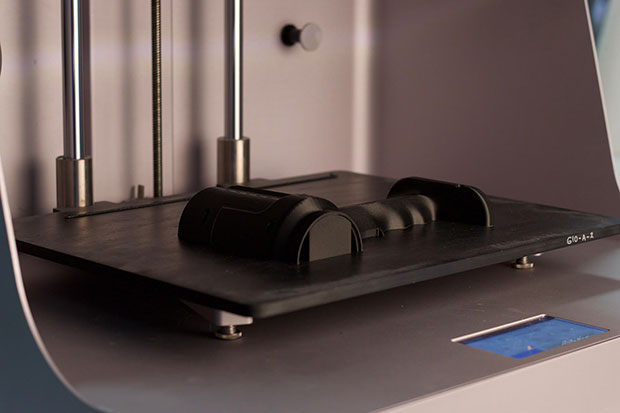 “5 Ways to Increase Bandwidth on Your CNC Mill with a Desktop 3D Printer” examines how 3D printers and engineering-grade materials can handle one-off jobs like making fixtures that take your mill out of revenue-generating production. Image courtesy of Markforged Inc.
After fleshing all that out, the paper steps through the five ways 3D printing maximizes your CNC. The first four are hands-on: 3D-printing fixtures like soft jaws, fixtures for flats and plates, gauges for quality control and making non-marring and modular fixtures. We'll get to number five in a sec.
None of those reasons merely asserts the benefits of 3D printing for the job; they are also mini testimonials from people in the trenches. So, the guy 3D printing soft jaws to hold complex shapes for drilling at difficult angles tells you he saved time and parts look fine and fit perfectly. And the guy making nylon gauges reports the parts match the quality of the aluminum tools he once used but cost less and are quicker to make.
Number five is materials. The angle here is selecting effective 3D print materials for jobs in the shop. It briefly discusses ABS, tough photopolymers, nylon and fiber-reinforced plastics. A chart provides a visual comparison of the strength, stiffness and environmental resistance of these materials versus aluminum.
Terrific stuff. Hit today's Check it Out link and download “5 Ways to Increase Bandwidth on Your CNC Mill with a Desktop 3D Printer.” You won't regret it.
Thanks, Pal. – Lockwood
Anthony J. Lockwood
Editor at Large, DE


Anthony J. Lockwood is Digital Engineering's founding editor. He is now retired. Contact him via [email protected].
Follow DE
Join over 90,000 engineering professionals who get fresh engineering news as soon as it is published.






About Us · Contact Us · Editorial Team · Advertising · Privacy Policy · Subscriber Services · © 2026 Digital Engineering 24/7 · Peerless Media