Helping design and engineering professionals discover, evaluate and specify technologies and processes that shorten the design cycle and enable success.




May 2026 Special Focus: Artificial Intelligence in Design and Simulation
In this Special Focus Issue, learn about the latest developments in the integration of artificial intelligence into engineering workflows.

April 2026 Special Focus Issue: Generative Design
In this Special Focus Issue, Digital Engineering takes a look at how generative design solutions can be used across different types of design problems and with a variety of manufacturing approaches to accelerate design space exploration, and…
In early 2019, the analyst firm ABI published the “Generative Design Vendor Ranking” report, described as a competitive assessment study. The top spot went to Autodesk, giving it bragging rights over rivals such as Siemens, PTC and Dassault Systèmes.
“The market for software with generative design tools will grow at a compound annual growth rate of 24% to reach US$44.5 billion for over 16 million seats in 2030,” according to ABI. “These sales include licenses and subscription revenues for computer-aided design [CAD] products with generative design tools or standalone generative design software products.”
“The automotive industry represents the largest opportunity globally with US$18.5 billion in generative design software revenues forecasted for 2030,” Pierce Owen, principal analyst at ABI Research, noted.
Since the report’s publication, COVID-19 and supply chain disruptions have emerged, putting many positive trends in jeopardy. Digital Engineering spoke to industry watchers to understand if generative design (GD) adoption and deployment are slowing down or holding up in the pandemic.
Before his role as an analyst, Stan Przybylinski was manager of Market and Competitive Intelligence for Dassault Systèmes, one of the key players in the CAD and simulation software market. This gives Przybylinski, VP of CIMdata, not just an analyst’s perspective, but also an insider’s view.
“I don’t think that COVID-19 is really blunting GD adoption, other than perhaps slowing some expenditures. On the other hand, many companies see this disruption as an opportunity to make important changes in their operations and enabling technologies,” observes Przybylinski.
Simon Hailstone, principal consultant at Cambashi, believes the fate of GD is invariably linked to the fortunes of heavy simulation users. “The current downturn has huge impacts on certain industries, like aerospace, automotive and oil & gas. With aerospace, we’re talking impact across the supply chain. Other industries, like health care, seem to be holding up. The high-tech industry is also showing resilience.”
When upper management tightens its belt in response to an economic downturn, emerging technologies such as GD are on shaky ground.
“GD gives you fantastic cost optimization opportunities. On the other hand, it also represents a significant investment. We may not really know how things look until next year. 2021 is a more critical year for us to look at the market,” Hailstone says.
“My intuition is the graphs for GD’s growth should be similar to or slightly better than the design space exploration and automation segments,” Joe Walsh, CEO of IntrinSIM, observes.
Design space exploration and simulation encompass classic CAD and simulation programs. GD, in many analysts’ view, is an offshoot of these markets.
“But there isn’t enough data, and there’s not an easy way to get the data,” Walsh says. “Maybe the product managers might have that information, but usually it’s included in something else.”
The challenge in assessing the generative design market is twofold: Because GD is a relatively new branch of simulation, the financial data, licensing models and seat counts are too limited to offer a historical perspective. Furthermore, GD is sometimes offered as an integrated part of CAD, sometimes as an independent tool of its own and sometimes as part of geometry preparation tools for 3D printing. This leaves the analysts with scrambled pieces of a jigsaw puzzle.
In the report titled “A Vision for Generative Design,” released in February 2019, IntrinSIM proposes a checklist for evaluating GD tools.
The firm proposes that, based on the software’s ability to consider a wide range of design parameters—such as weight, mass, temperature, fatigue, manufacturing process—as constraints, the solution can be graded as (1) Limited, (2) Basic, (3) Functional, (4) Advanced or (5) Comprehensive.
The firm further proposes that the tool be subjected to these benchmarks on a number of contexts: Handling all appropriate objectives and constraints; handling multiple load conditions; handling multiphysics; and so on.
“Every six months or so, a major release of GD software will come out, and I’d see dramatic improvements,” says Walsh. “In my opinion, nobody gets a Comprehensive grade right now across the spectrum. There are a couple of tools that get Advanced grade on several fronts.”
For example, Walsh would place Autodesk Fusion 360’s GD between Functional and Advanced in terms of cost-based optimization. On the other hand, due to a lack of assembly-level GD, he would give the software a Basic grade in the assembly context.
“If someone just needs component-level GD with costing considering, Fusion 360 is an excellent fit. For someone who needs assembly-level GD, maybe not,” Walsh says.
Cambashi’s Hailstone believes GD may have a role to play in the COVID-era space management crisis, brought on from social distancing requirements. Enclosed spaces such as train stations, bus terminals and bus interiors, for example, may need to be reconfigured and sectioned off to keep people 6 ft. apart. The airflow within public spaces may need to be controlled to minimize pathogen transfer. Applying GD to these problems would allow engineers to consider a range of options simultaneously.
“In the context of public health, this could be a real game changer,” says Hailstone. “Much of it has to do with using simulation to figure how to redesign the existing spaces. We know, for example, office spaces need to change significantly.”
Though GD relies heavily on artificial intelligence-like algorithms, Hailstone believes the role of the human expert is indispensable.
“We have to make it easier for the engineers to define a problem, then let them make the final decision. The decision-making tools should give them enough information to show how the software gets to the answer. That workflow would work quite well,” he says.
Autodesk Fusion 360, Altair’s solidThinking and their rivals in the mainstream CAD segment represent established players with GD offerings. Newcomer Frustum was acquired by PTC in 2018, leaving a handful of startups (nTopology, ParaMatters and SciArt) in the pool.
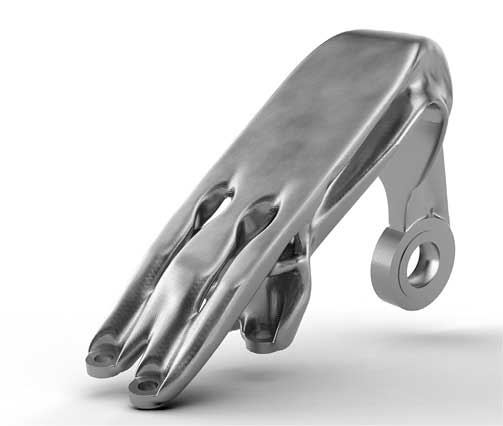
For those on a quest for a GD solution, Walsh says the goal is not necessarily to search for a tool with a Comprehensive rating, but to find one that offers the desired features.
“Nobody needs everything,” he says. “Someone might need support for assembly contact as a constraint, but they may not need lattice structures.”
The GD software sector as a whole, Walsh reasons, is presently somewhere between Basic to Functional, poised to cross the threshold. He predicts some vendors may eventually choose to specialize in specific GD applications rather than offer generalized solutions, which could be too complex to learn or use for average design engineers.

CIMdata Consulting provides a comprehensive set of unbiased and independent strategic management consulting services. CIMdata offers guidance and support to industrial organizations and PLM solution providers. We maintain a strategic…

Kenneth Wong is Digital Engineering's resident blogger and senior editor. Email him at [email protected] or share your thoughts or suggestions at digitaleng.news/facebook.
Follow DE
Join over 90,000 engineering professionals who get fresh engineering news as soon as it is published.






About Us · Contact Us · Editorial Team · Advertising · Privacy Policy · Subscriber Services · © 2026 Digital Engineering 24/7 · Peerless Media