Helping design and engineering professionals discover, evaluate and specify technologies and processes that shorten the design cycle and enable success.




May 2026 Special Focus: Artificial Intelligence in Design and Simulation
In this Special Focus Issue, learn about the latest developments in the integration of artificial intelligence into engineering workflows.

April 2026 Special Focus Issue: Generative Design
In this Special Focus Issue, Digital Engineering takes a look at how generative design solutions can be used across different types of design problems and with a variety of manufacturing approaches to accelerate design space exploration, and…
Mark Norwood, who had previously won our 3D printable cubicle toy design contest with his take on a tank, was inspired by the Christmas spirit to design a marble ball roll in the shape of a Christmas tree. Like many good designs, this too was a new iteration of an existing design. Step by step, he reshaped the original helix-shaped core into a cone, until it became a layered pine tree with dangling silver ornaments.
The ornaments were more than decorative. For 3D printing, it served a purpose. "In the first version, I had a problem with the upper part of the track that had no support. Unless the filament was very new and dry, it would create some artifacts. So I added decoration to add interest and to give the upper wall support," revealed Norwood. When he started the design, it was summer. The humidity wrecked havoc with the filament. "It would string and droop," he recalled.
"The second version used ribbing for the support. It gave the marble run an architectural feel. My wife said it reminded her of a parking garage."
As Christmas approached, Norwood decided to create a seasonal version of his marble run in the shape of a pine tree. But he was confronted with new challenges. "First, the runs would need more support than the helical version because the run toward to bottom was longer. Second, as the spiral widened, the ball would slow down, so much that it would loose momentum before it got to the bottom," he revealed.
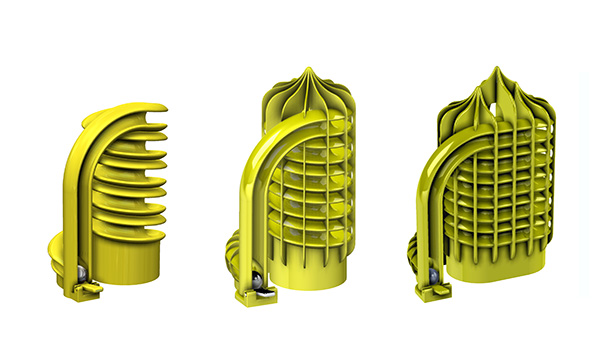
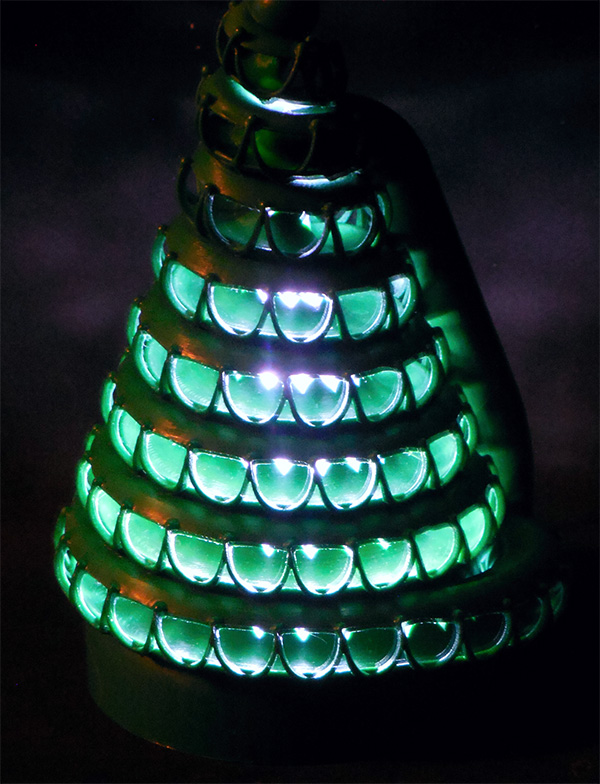
His solution was to refine the slope angle to maintain the ball's speed. He also decided to support the track with bunting, with balls in between each swag of the bunting. "I was playing with some tealights and thought, wouldn't it be nice to be able to light the marble run like a Christmas tree? With the software, I pierced the track on the back wall with dozens of four pointed stars," he recalled.
Norwood used SOLIDWORKS Standard 2025 to design all the marble runs. He used RealView Graphics that comes with the software to render the still images. The design was printed on a Bambu Lab A1 Mini Combo. He gave a few of the printed versions to potential customers.
"My goal was to print a good-looking object without having to remove supports. So I made supports that were part of the design's aesthetic qualities," he noted.


Kenneth Wong is Digital Engineering's resident blogger and senior editor. Email him at [email protected] or share your thoughts or suggestions at digitaleng.news/facebook.
Follow DE
Join over 90,000 engineering professionals who get fresh engineering news as soon as it is published.






About Us · Contact Us · Editorial Team · Advertising · Privacy Policy · Subscriber Services · © 2026 Digital Engineering 24/7 · Peerless Media