Helping design and engineering professionals discover, evaluate and specify technologies and processes that shorten the design cycle and enable success.



Digital Engineering April 2026
In the latest issue of Digital Engineering, we take a look at the latest innovations in design for additive manufacturing, including the use of natural language inputs, social media cosplayers, and AI integration. The issue also includes a feature…

January Special Focus Issue: Design for Additive
In this Special Focus Issue of Digital Engineering, learn about the latest advancements in design for additive manufacturing, including new software tools, additive in automotive, custom medical devices, and more.
A cooperative venture between the University of Illinois at Urbana-Champaign and the Wyss Institute at Harvard University has successfully built lithium-ion microbatteries the size of a grain of sand, using additive manufacturing (AM). According to the research team, this also represents the first time batteries have been 3D printed. The results of the study were printed in the June 18 online edition of Advanced Materials.
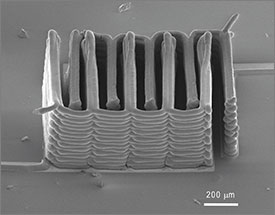
"Not only did we demonstrate for the first time that we can 3D-print a battery, we demonstrated it in the most rigorous way," said Jennifer Lewis, Ph.D., senior author of the study, and a Core Faculty Member of the Wyss Institute for Biologically Inspired Engineering at Harvard University.
To build the microbatteries, the team first mixed up two batches of electrochemically active inkjet material. Both contained nanoparticles of a lithium metal oxide compound and one was used to build the anode, while the other was used to build the cathode. The printer laid out the anode and cathode in interlocking comb shapes. From there, the proto-battery was packed into a container, which was filled with an electrolyte solution to juice up the battery.
"The electrochemical performance is comparable to commercial batteries in terms of charge and discharge rate, cycle life and energy densities. We're just able to achieve this on a much smaller scale," said Shen Dillon, an assistant professor of materials science and engineering at the University of Illinois.
Not only could these batteries power your gadgets in the future, they could also provide energy for life-saving medical implants, and a new generation of robotics. This could even lead the way toward entirely AM-built devices, starting with the shell and working inward on the electronics and battery.
Below you’ll find a short video of the battery being constructed.
Source: Wyss Institute


John Newman is a Digital Engineering contributor who focuses on 3D printing. Contact him via [email protected] and read his posts on Rapid Ready Technology.
Follow DE
Join over 90,000 engineering professionals who get fresh engineering news as soon as it is published.






About Us · Contact Us · Editorial Team · Advertising · Privacy Policy · Subscriber Services · © 2026 Digital Engineering 24/7 · Peerless Media