Helping design and engineering professionals discover, evaluate and specify technologies and processes that shorten the design cycle and enable success.




Artificial Intelligence for Design and Engineering Workflows
In this white paper, learn how artificial intelligence and machine learning can improve design and simulation.
Technology Focus: Designing for Optimization & Simulation
Simulation is pervasive, with people from different departments and backgrounds discovering new ways to put it to use, in all of its varied forms.
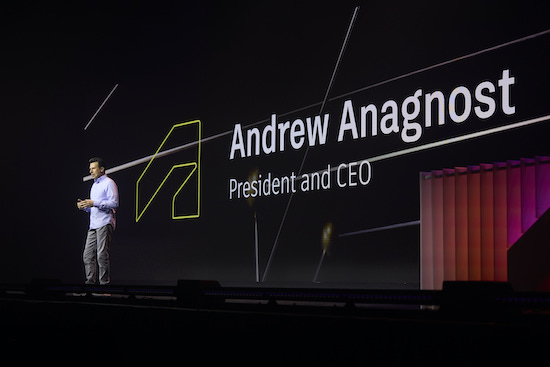
At AU 2025, Autodesk rolled out new levels of artificial intelligence (AI) functionality across its suite of products for manufacturing, architecture/construction, and media/entertainment. The company demonstrated more advanced capabilities for its AI-based Autodesk Assistant within Fusion. Autodesk President and CEO Andrew Anagnost also showed off generative AI capabilities in Fusion that will allow users to go from natural language prompts to an editable CAD model in just a few minutes.
“AI and machine learning models are capable of advanced reasoning, and it’s happening faster than any of us can absorb,” Anagnost said during his keynote. “We are heading into the agentic AI era, and the [technology] will help you save time, innovate faster, and make better decisions.”
In a press conference later in the day, he also noted that while many of Autodesk’s AI enhancements were targeted at cloud platforms like Fusion, edge devices and workstations are increasingly powerful, and that “what happens on the cloud will happen on the edge, too.”
For existing users of popular tools like AutoCAD and Inventor, Dell Technologies and NVIDIA were on hand displaying powerful Dell Pro workstations and NVIDIA RTX PRO™ GPUs targeted at high-performance design, rendering, and AI-based workflows.
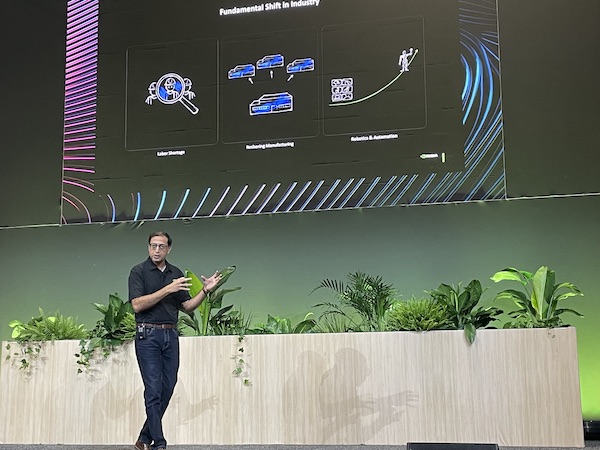
In an expo floor presentation titled “Unleashing the Power of Professional GPUs” Himanshu Iyer, Manufacturing Industry Marketing & Strategy Lead at NVIDIA and Ken Flannigan, Alliance and Solutions at Dell, outlined how advanced hardware can help improve design workflows.
Flanigan opened the session explaining that typical modeling applications are low-threaded, and their performance is directly affected by the use of high-frequency CPUs. GPUs and neural processing units (NPUs) handle other computing loads locally on the workstation. NPUs (in the latest Dell models) shift minor AI-related compute tasks away from the GPU, improving performance and freeing up GPU capacity for more complex AI workloads such as training, fine-tuning, and engineering workflows like AI-enabled design, rendering and simulation.
The important point to remember is that scalability is key; the workstation should match the workflow and companies should carefully assess their evolving AI, visualization and collaborative needs when it comes to professional workstations. “For most Autodesk users bigger is not always better,” Flanigan said. “For most Autodesk customers, we would guide them to smaller form factor towers with high-frequency CPUs and a robust selection of NVIDIA RTX PRO GPUs based on their workflow.”
Iyer noted that more companies are looking to generative AI technologies to help address cost and staffing challenges around product development and manufacturing. Referencing the Autodesk announcements around generative AI to create models from prompts, he said that “It is going to become easier to use these technologies moving forward as more and more AI-powered features are added to ISV applications like Autodesk Fusion..Generative AI models are improving rapidly and it’ll drastically change the way designers and engineers come up with design concepts and variants. ”
AI is also increasingly prevalent in engineering simulation workflows, factory floor optimization, predictive maintenance and other operations. “For AI to be successful, you need the right type of compute, which is done primarily on GPUs. It is much more efficient.”
Current desktop NVIDIA RTX PRO GPUs are based on the NVIDIA Blackwell architecture, including a massive increase in available memory on the GPU – up to 96 GB in the RTX PRO 6000 Blackwell Workstation Edition and RTX PRO 6000 Blackwell Max-Q Workstation Edition GPUs, a level previously only available on data center GPUs. In product development applications, RTX PRO GPUs can provide 1.5x to 3x performance improvements for CAD, rendering, simulation and other applications. For AI development throughput, they offer between 2x to 5x performance improvements.
Those improvements allow workflows like AI model training and inferencing to be done locally on a desktop workstation. A later presentation from Dell showcased how the Dell Pro Max GB10 (powered by the NVIDIA Grace Blackwell architecture) enables secure, high-performance local AI development.
The announcements that Autodesk made around their AI capabilities will reinforce the need for robust compute capabilities on the desktop.
“When collaborating around large scale 3D models with data, the role of the local machine is only going to get more important,” Flanigan said in a briefing. “These tools increase the need for interaction with the models. In collaborative environments, the local compute requirements around large data sets across multiple applications are going to be even more important.”


Brian Albright is the editorial director of Digital Engineering.
Contact him at [email protected].

Join over 90,000 engineering professionals who get fresh engineering news as soon as it is published.






About Us · Contact Us · Editorial Team · Advertising · Privacy Policy · Subscriber Services · © 2026 Digital Engineering 24/7 · Peerless Media