Helping design and engineering professionals discover, evaluate and specify technologies and processes that shorten the design cycle and enable success.



Digital Engineering April 2026
In the latest issue of Digital Engineering, we take a look at the latest innovations in design for additive manufacturing, including the use of natural language inputs, social media cosplayers, and AI integration. The issue also includes a feature…

January Special Focus Issue: Design for Additive
In this Special Focus Issue of Digital Engineering, learn about the latest advancements in design for additive manufacturing, including new software tools, additive in automotive, custom medical devices, and more.
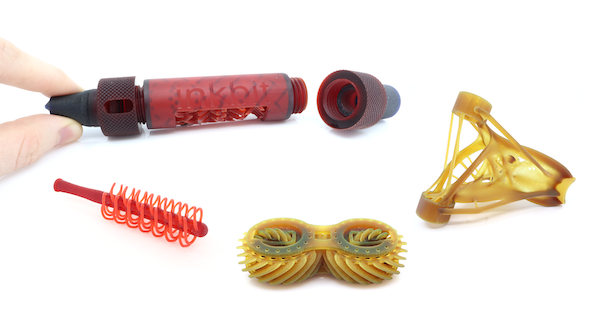
As company officials describe it, the Inkbit 3D printer is a multi-material ink-jet platform with eyes and brain. In simple terms, the jetting-based additive manufacturing system employs machine vision and machine learning/artificial intelligence (AI) capabilities to learn the properties of materials, predict behavior, and adjust printing over time. The goal: High precision, multi-material production-grade output.
The start-up company, spun out from MIT’s Computer Science and Artificial Intelligence Laboratory (CSAIL) in 2017, is based on research led by Professor Wojciech Matusik and intellectual property licensed from MIT. Inkbit saw reason to create a new platform for 3D printing because while they believed there was substantial opportunity for ink jet AM capabilities, the technology was only being used for prototyping, not production applications since it wasn’t able to easily take advantage of engineering-grade materials like silicone and epoxy.
“Today, material used for ink jet printers are not usable in production form—they are only useful for making prototypes,” says Davide Marini, Inkbit co-founder and CEO. “What we wanted to achieve is to develop a system that is able to output multi-material products with engineering-grade materials and performance.”
While material jetting as a technology is highly scalable, use cases remain curtailed because of the difficulty pushing engineering-grade materials like epoxy through small nozzles on the printhead and the need to leverage a host of chemistry tricks to get optimal performance. “Unlike injection molding processes where properties are defined from the beginning, with ink jet printing you build the chemistry during the manufacturing process through UV curable resin and polymerization,” Marini explains. “That’s why it’s stayed a small niche.”
Inkbit’s design, which introduces a vision system and intelligence, helps address the bottlenecks and material limitations of ink jet technology. The vision system scans every layer deposited by the ink jet in real time, ensuring any deviations are caught and corrected on the spot—in other words, the eyes of the system. “Because we scan immediately, we can fill in missing material in the next layer,” he explains. “We don’t just stop and fill holes, we continue to print fast at a higher level.”
The machine learning and AI capabilities, the brain, if you will, enable the printer to learn over time, adjusting the way it prints specific geometries and materials to ensure the highest levels of quality. The internal scanner also maintains a digital record of every part printed; this, coupled with the intelligence, creates an automated quality control feedback loop to ensure the highest levels of production-grade part performance, Marini says.
Inkbit’s printer is currently available to select customers, including Johnson & Johnson, as part of an early release program. The first systems will ship to select customers in 2021.
Check out this video to learn more about the Inkbit printer’s technology.


Beth Stackpole is a contributing editor to Digital Engineering. Send e-mail about this article to [email protected].
Follow DE
Join over 90,000 engineering professionals who get fresh engineering news as soon as it is published.






About Us · Contact Us · Editorial Team · Advertising · Privacy Policy · Subscriber Services · © 2026 Digital Engineering 24/7 · Peerless Media